


“I can’t speak well.” That was Moses’ objection at the burning bush, and it may be the oldest excuse in the history of calling.
When God appeared to Moses in fire and smoke, commanding him to confront the most powerful ruler on earth and lead an entire nation to freedom, Moses didn’t argue about the mission. He didn’t say the task was too dangerous, or that Pharaoh was too powerful. He argued about himself. About his qualifications. About what he couldn’t do. “I am slow of speech and tongue,” he protested. “Please send someone else.”
It’s tempting to judge Moses from this distance, standing safely outside the burning bush, never having been asked to confront a pharaoh. But if we are honest, his objection is the most human thing in the story. Most of us have whispered that prayer in reverse: Lord, don’t use me for this. I’m not the one you want.
God’s response to Moses, however, wasn’t a pep talk. It wasn’t reassurance that he was more eloquent than he thought. It was something far more sobering, and far more freeing.
“Who gave human beings their mouths? Who makes them deaf or mute? Who gives them sight or makes them blind? Is it not I, the LORD? Now go; I will help you speak and will teach you what to say.”
Exodus 4:11–12
Translation: Your mouth? I made it. Your weakness? I already know about it. Now stop negotiating, and go.
Fast-forward to Deuteronomy 31. Moses, the man who couldn’t speak well, has just finished writing five books of Scripture. And now God asks him to compose a song. Not just any song: one that will be sung across three thousand years of human history. The man who wanted to disqualify himself became one of the most consequential voices the world has ever known.
“The unqualified didn’t become qualified. He became unstoppable, which is an entirely different thing.”
The Pattern God Seems to Love
Moses is not an anomaly. He is a template. Read the Scriptures long enough and a pattern emerges so consistent it cannot be coincidence: God displays a stunning preference for people who have every reason to disqualify themselves.
It isn’t that God is unaware of their limitations, it’s that He appears to choose them because of their limitations. As if the gap between what is required and what the person can offer is the very space where God works best.
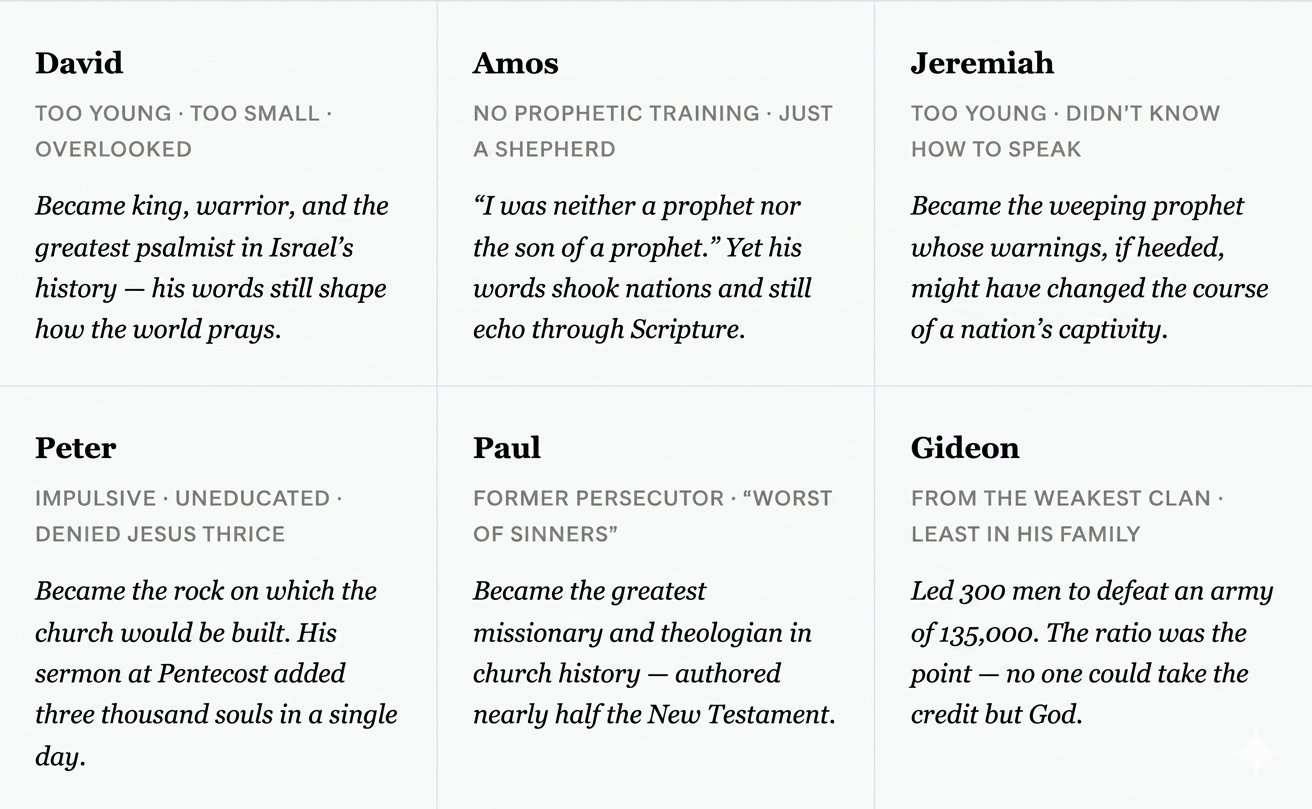
Do you see it? In every case, the limitation wasn’t incidental to the story. It was the story. The limitation was the setup for the miracle. The gap was where God stepped in.
Why God Operates this Way
There is a reason God works through the unqualified, and it isn’t because He enjoys making things difficult. It’s strategic. When the weak accomplish the impossible, everyone in the room knows it wasn’t human strength.
If God had chosen Egypt’s most eloquent orator to confront Pharaoh, people would have said: remarkable rhetorician. But when a stuttering shepherd parts the Red Sea, there is no question about the source of the power. The weakness becomes the proof. The limitation becomes the evidence.
“Therefore I will boast all the more gladly about my weaknesses, so that Christ’s power may rest on me… For when I am weak, then I am strong.”
2 Corinthians 12:9–10
Paul didn’t arrive at this insight easily. He had asked God three times to remove his weakness, what he called a “thorn in the flesh.” God’s answer was not yes. It was: My grace is sufficient for you. My power is made perfect in weakness. Paul’s response is extraordinary: he stopped praying for the thorn’s removal and started boasting about it. Not because he enjoyed suffering, but because he had understood something most of us haven’t yet: your “can’ts” are the very places where God’s “I can” shines brightest.
The Most Dangerous Prayer You Can Pray
Which brings us to the prayer. Not the safe prayer, the dangerous one. There is a safe version of surrender that most of us prefer: Lord, use my gifts. It feels spiritual, but it is actually quite comfortable. You offer only what you’re good at. You manage the risk. You stay in control. You know where the edges of your competence are, and you never stray too far from them.
The dangerous prayer is different. It refuses that bargain entirely: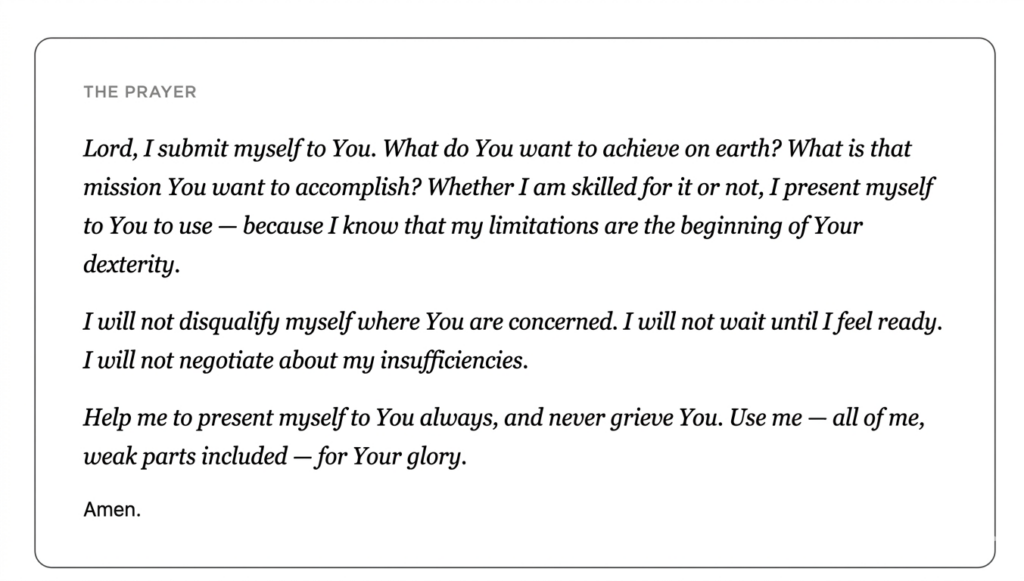
Why is this prayer dangerous? Because God will take you up on it. He will ask you to speak when you feel mute. He will send you where you feel unprepared. He will assign you work that exceeds your résumé, stretches your comfort zone, and sometimes exceeds your comprehension. He will take you past the edge of what you can manage and into the territory where only dependence on Him makes sense.
False Humility vs. Real Availability
Before we go further, an important distinction must be made. Not everyone who says “I’m not qualified” is being genuinely humble. Some of us use that language as a disguise for something else, disobedience dressed in the language of modesty.
Moses did this. God had to get firm: “Stop making excuses. I made your mouth. Now go.” The difference between false humility and real availability is not in the words. It is in what those words are pointing toward.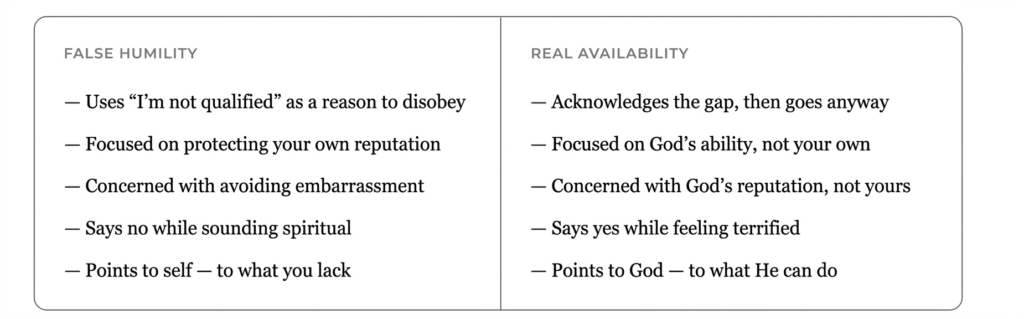
The right question is never Am I good enough? The right question is always: Is He faithful enough? And the answer, across every page of Scripture and every generation of human history, is an unqualified yes.
What to Expect When You Actually Pray It
When you pray this prayer and mean it, something shifts, both internally and in the situations you encounter. Here is what the biblical record, and the testimony of those who have prayed it since, suggests you can expect.
1. You stop waiting to feel ready
Moses could have spent another forty years in the wilderness, working on his rhetoric. But God did not need him ready. He needed him available. Readiness is often a comfortable fiction we construct to delay obedience. Availability is the thing God is actually asking for.
2. Your limitations begin to look different
They are no longer disqualifications, they are the proof that whatever happens next cannot be credited to you. Your weakness becomes a megaphone for God’s strength. You stop hiding your gaps and start recognising them as the canvas on which He works most visibly.
3. Rejection loses its power over you
When you are not operating on your own strength, you cannot be depleted by your own insufficiency. Criticism does not derail you the same way. Failure does not define you the same way. You are not the source, so you cannot be the cause of the collapse.
4. You become fruitful in ways you cannot take credit for
And this, perhaps more than anything, is how you know that God is in it. When the results are disproportionate to your input. When the impact exceeds your ability. When you finish and cannot quite explain how it happened. The glory goes to Him, not to you. And that is exactly how He wants it.
5. You receive assignments you did not expect
Like Moses at 120, being asked to write a song. Like Peter the fisherman, being asked to lead a global movement. Like Paul the church-persecutor, being asked to plant the very churches he once destroyed. Availability does not restrict God’s assignments to your comfort zone. It opens the full range of His purposes to you.
“God isn’t looking for the impressive. He’s looking for the available. He doesn’t need your competence. He needs your surrender.”
Your Limitations Are His Canvas
Isaiah prayed the dangerous prayer with breathtaking simplicity: “Here am I. Send me!” He did not ask where. He did not ask how. He did not negotiate the terms. He simply made himself available, and the assignment came.
 Mary prayed it as a young, unmarried girl in a culture where an unexplained pregnancy could cost her everything. “I am the Lord’s servant. May your word to me be fulfilled.” The cost was real. She said yes anyway. And she became the vessel through whom the salvation of the world was carried.
The disciples prayed it when they had no idea where following Jesus would lead, through storms and triumphs, through betrayal and resurrection, through imprisonment and transformation. They left their nets without a destination. They just knew who they were following.
What they all shared was not gifting, or eloquence, or experience. It was availability. An open hand. A willingness to be used outside the boundary of what felt safe.
Moses couldn’t speak well. But the words God gave him changed the world, and the song he wrote at 120 is still being sung. What might God accomplish through your “can’ts,” if you simply stopped disqualifying yourself? What might He write through your limitations, if you offered them not as reasons to stay still, but as canvas for Him to work on?
The question is not whether God can use you. He made your mouth. He knows your weakness. He has already accounted for every gap.
The only question, the only one that actually matters, is whether you are available.




4 thoughts on “Unqualified and Unstoppable: The Dangerous Prayer of Availability”
This is truly powerful Mr Leke. What touched me most is the reminder that God is not looking for perfect people but willing hearts.
Moses had weaknesses, Mary faced fear and uncertainty and the disciples did not know where the journey would lead, yet they all said yes to God.
“Your limitations are His canvas” is such a beautiful line. The very things we think disqualify us may be the things God wants to use for His Glory. Yes o😀
This piece is inspiring and deeply encouraging. Thank you for sharing this timely reminder that the most importnt thing is simply being available to God regardless of our limitations.
May God bless your pen sir.
Amen. May the Lord bless your lips and pen too Rhoda. I look forward to a time of reading your publication too.
God takes the foolish things of this world to confound the wise. He uses what you and I may discard to regard a man. I am glad you were touched and reminded. May the Spirit of the Lord continually minister to you and make you stronger for His glory. Thank you for commenting.
This is a masterpiece I’m so glad to come across this and also to draw from the well of knowledge
Thank you dear John for your comment. You may consider yourself unqualified, but the Lord who has called you to a task makes you unstoppable.