

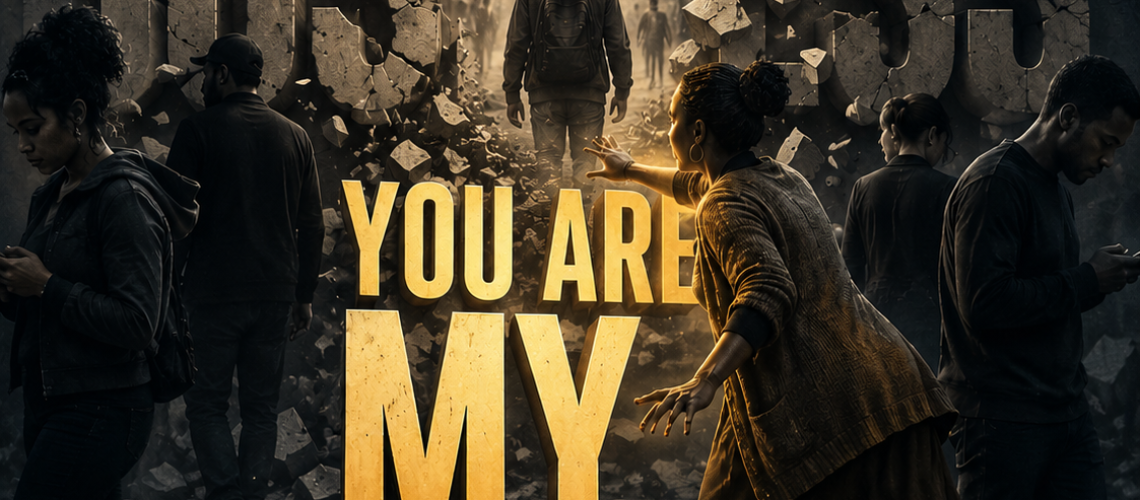
…..but who will speak up?
I need someone to take me back to the days when discipline wasn’t just a parent-to-child affair, but a societal responsibility.
Take me back to when wrongdoing was called out immediately, without fear of being insulted, dragged, or labeled “judgmental.”
Take me back to when truth-tellers were the loudest voices in the room, not silent observers standing in the corner.
Take me back to the sane days. The normal days.
These thoughts occupied my mind recently as I reflected on what society has become.
My reflection carried me back to one particular memory from my childhood.
I was in junior secondary school, living with my parents. I had done something wrong, and as was common in many Nigerian homes at the time, discipline often came with a serious consequence. The mere thought of my father’s belt was enough to inspire what I believed was a brilliant plan.
I decided to run away.
Being the writer that I have always been, I left a letter behind. In it, I explained that I loved my parents and loved my home, but I dreaded the discipline that awaited me. I informed them that I was leaving to start a new life on my own and assured them that when I became older, I would eventually return.
After dropping the letter, I quietly slipped out of the house.
My route to freedom was through a lonely street surrounded by bushes. You could walk for several minutes before seeing another house. As I entered the road, I suddenly heard footsteps behind me.
Terrified that my parents had discovered my escape, I ran into the bush and hid.
A few moments later, a voice called out, “Who is there?”
I stayed silent.
The voice called again.
This time, shaking with fear, I stepped out.
To my surprise, it was a woman from church who knew both me and my parents very well. She asked what had happened, and through tears and fear, I explained everything.
She listened, comforted me and promised to speak to my parents on my behalf.
Relieved, I followed her home.
When we arrived, my parents were already worried and discussing how to search for me. True to her word, the woman appealed to them to forgive me.
Then she said something that completely shocked me.
She told them I still needed to be disciplined. Not for the original offence but for running away.
She explained where she had found me and reminded my parents of the kind of people who often lingered around that area. What if she had not been the one who found me? What if someone with bad intentions had?
Her point was simple: my actions had placed me in danger, and that could not be ignored.
Dear reader, I will spare you the details of what happened afterward. Let’s just say that I never attempted to run away again. Even now, as an adult, the thought would never cross my mind.
At the time, however, I disliked that woman immensely.
She was a snitch. At least, that’s what I thought.
Years later, I found myself correcting two teenagers for littering the street. To my surprise, they responded respectfully and immediately picked up what they had thrown away.
Afterward, a thought crossed my mind.
What if they had insulted me?
Because that is often the reality today.
Many people are reluctant to correct wrongdoing, not because they approve of it, but because they fear the backlash that may follow. Sometimes it is the young person who responds aggressively. Other times, it is the parents who feel offended that anyone dared to intervene.
And suddenly, I understood that woman differently.
While I still believe she could have handled my trust better, I now appreciate what she represented.
She belonged to a generation that believed children were not only the responsibility of their parents but also of the community around them.
Growing up, it wasn’t easy to go completely off track because there were eyes everywhere—not eyes looking to embarrass you, but eyes looking to guide you.
The Yoruba have a saying:
“Ojú méjì ni ń bí ọmọ, ṣùgbọ́n igbá ojú ni ń tọ́ ọmọ.”
Meaning: Two eyes may give birth to a child, but hundreds of eyes help raise that child.
That proverb captures an important truth.
No one was expected to abuse or mistreat children. But when a child was heading in the wrong direction, responsible adults intervened. They corrected. They advised. They informed parents when necessary.
Those collective acts of responsibility helped keep society grounded.
So what happened?
When did correction become interference?
When did accountability become oppression?
When did speaking up become a greater offence than doing wrong?
Today, many people choose silence because silence is safer.
Nobody wants to be called a moralist.
Nobody wants to be accused of “doing too much.”
Nobody wants to become the target of online outrage or public ridicule.
And so we look away.
We look away when values are eroded.
We look away when dishonesty is celebrated.
We look away when standards collapse.
We look away when leadership fails.
We look away when truth becomes inconvenient.
But the problem is that every society pays a price for prolonged silence.
A society does not decay because evil becomes louder; it decays because good people become quieter.
This is why the conversation goes beyond children littering the streets or neighbours correcting one another. What we are witnessing is a deeper cultural shift.
We have become so afraid of offending people that we now hesitate to save them from themselves.
But correction is not cruelty. Indifference is.
Truth has become so rare that those who speak it are often treated as the problem.
Edmund Burke is often credited with saying:
“All that is necessary for the triumph of evil is that good men do nothing.”
Whether in our homes, communities, institutions, or leadership structures, we cannot continue choosing comfort over courage. Real change requires people who are willing to speak when silence would be easier.
People who are willing to stand for what is right, even when it is unpopular.
People who understand that accountability is not hatred and correction is not condemnation.
Because the village that once helped raise children is slowly disappearing.
And if we continue to watch from a distance while everything falls apart, we may eventually discover that what we called “minding our business” was simply another way of abandoning our responsibility to one another.
Perhaps what society needs today is not more spectators. Perhaps it needs more people willing to care enough to speak.
Will you keep looking away?