

My wife did something in the kitchen today that I have not stopped thinking about.
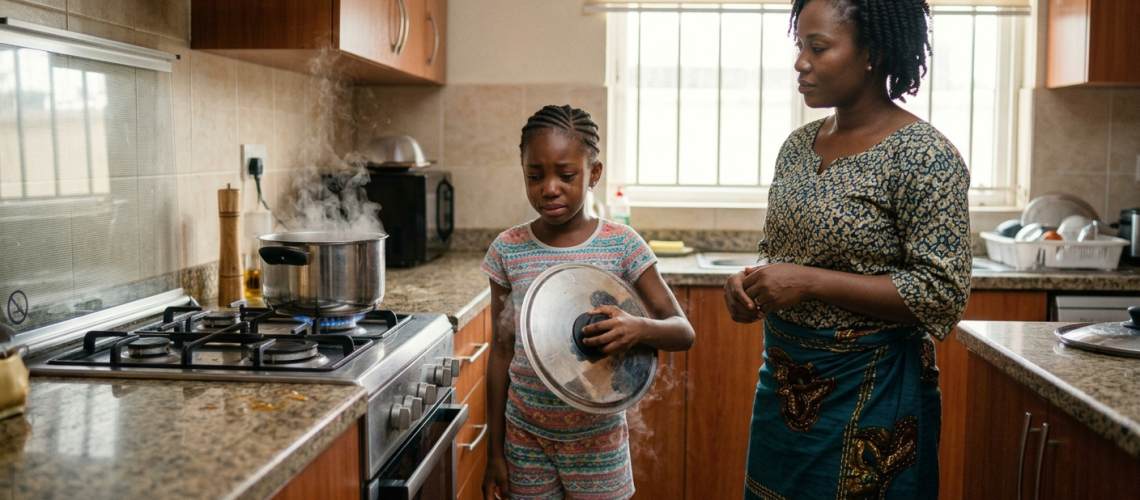
She asked our daughter to check a pot of boiling pepper soup on the cooker. The lid had a rubber handle, no risk of burning whatsoever. But our daughter was afraid. She hesitated, found reasons to delay, looked for a way out of the task. My wife saw all of this and insisted anyway.
In her fear, our daughter lifted the lid and dropped it. It hit the surface with a loud crash that startled everyone in the room. Fortunately, nothing broke.
My wife did not rush in to comfort her, take over, or make the moment easier. She looked at her calmly and said: pick it up and place it on the slab.
Amidst tears, our daughter picked up the lid and placed it on the slab.
And just like that, one fear was conquered.
If my wife had stepped in, even gently, even kindly, even out of pure love, our daughter would have walked away from that kitchen with the same fear she brought into it. The moment would have passed. The fear would have remained. And the world, at some point, would have introduced her to a version of that same fear without a mother standing nearby, without a rubber-handled lid, and without a safety net.
That is what my wife understood in that moment. And it is what I want to explore here.
The Pain We Are Trying to Spare Them
Every loving parent shares the same instinct: protect your child from hurt.
We see them struggling and we want to step in. We see them afraid and we want to remove the source of the fear. We see them failing and we want to smooth the path so that the failure does not land too hard.
This instinct is not wrong. It comes from a good place. It comes from love.
But there is a version of this instinct that, when left unchecked and never balanced, quietly becomes one of the most harmful things we can do to our children.
When we shield a child from every painful experience, every difficult task, every moment of fear or frustration or failure, we do not eliminate pain from their life. We simply delay it. And we hand over the responsibility of introducing it to someone, or something, far less qualified than we are.
The world will introduce our children to pain. That is not a possibility. It is a certainty.
The only question is whether they meet it first in the guided, loving, safe environment of their home, where a parent is present to coach them through it, or whether they meet it alone, unprepared, in circumstances that have no interest in their growth.
The Parent as the First Introducer
My wife put it simply and I have not been able to improve on her words.
Parents should learn to be the first introducers of pain to their children, rather than shielding them so much from pain that life becomes the first introducer. Children will crash easily under the weight of the world’s pain. But if they have been formed and trained under the guided, painful coaching of their parents, they are able to withstand what the world gives them.
The parent who introduces pain first does so with context. With explanation. With presence. With love.
The parent says: this is hard, and I know it is hard, and I am here, and you are going to do it anyway. And when you do, you will know something about yourself that you did not know before.
The world says nothing. It simply applies pressure and watches what happens.
A child who has never been allowed to struggle, to fail, to feel afraid and push through anyway, has no frame of reference for difficulty when it arrives. And it will arrive. It always does. The question is only whether they have been prepared to meet it.
What It Looks Like in Practice
Let me give you another example from the same day.
Our daughter woke up in the middle of the night because her bidet spray was making a faint, whispering sound, a small fault in the fitting. It startled her, and she could not settle back to sleep.
When I heard the story in the morning, two things struck me.
The first was admiration for my wife’s patience in attending to her at 3 AM and again at 4 AM. I will be honest: I do not trust myself to have been so patient.
The second was the teaching conversation we had with our daughter afterwards.
We pointed out two things she could have done without waking either of us. She could have turned off the main control to stop the sound. Or she could have simply closed her toilet door. Neither solution required a parent. Both were within her ability. She simply had not thought to try.
We used it as an opportunity to say something she needs to hear more than once: she will not always have us. There will be nights, and there will be problems, and there will be moments of fear, when we are not in the next room to call for. She needs to begin practising now, in the small moments, the habit of attempting a solution before reaching for help.
This is not harshness. This is preparation.
The rubber-handled lid. The whispering bidet. These are not crises. They are rehearsals.
The Difference Between Cruelty and Preparation
I want to be careful here, because this argument can be misread.
This is not a case for withholding comfort from a child who is genuinely distressed. It is not a case for dismissing fear as weakness or refusing to help when help is truly needed.
There is a significant difference between a parent who stands beside a frightened child and says, “I know this is scary. Pick up the lid anyway,” and a parent who simply abandons a child to struggle alone and calls it toughening them up.
The first is guided discomfort. The second is neglect dressed in the language of strength.
What we are talking about is intentional, loving exposure to difficulty. The parent who spots an opportunity for their child to grow through a moment of fear or failure, and resists the urge to remove that moment, even though removing it would feel kinder in the short term.
The key word is guided. You are still there. You are still present. You are simply choosing not to do for them what they are capable of doing for themselves.
Let Them Drop the Lid
There will be moments when your child reaches for something difficult and drops it.
Let them.
And then, with the same calm that my wife showed in that kitchen, ask them to pick it up.
Not because you do not care that they dropped it. But because the picking up is the lesson. The doing of the hard thing after the failure is where the real formation happens. That moment, repeated across a childhood in small ways and large ones, is what builds a person capable of handling what life will eventually bring.
We are not raising children. We are raising the adults they are becoming. And the adults they are becoming will need to know how to drop something and pick it up again, without falling apart, without waiting to be rescued, without assuming that someone will always step in to make it easier.
We can teach them that now, in our kitchens, in our bathrooms, in the small ordinary moments of daily life.
Or we can protect them from it now, and leave it to the world to teach them later.
The world is not a gentle teacher.
We are.
Let us do our job.



15 thoughts on “The Kindness That Isn’t: Why Shielding Your Child from Pain May Be the Most Dangerous Thing You Do”
The world is not a gentle teacher…we are!!!
You’re absolutely right Lois. We trust ourselves to seek their best interest more than we do the world.
This is such an insightful and thought-provoking read. It’s beautiful to see parenting approached with so much love, patience and intentionality, guiding and correcting without cruelty. Truly, raising a child with love, even when the lessons may feel difficult, is one of the greatest gifts we can give them.
Thank you Treasure.
It may seem tough, but on the long run they’re better for it.
Mr Leke, this is such a powerful reminder. ❤️ We must not be so quick to shield our children from every difficulty or failure. Sometimes, allowing them to stumble, learn, fail and try again is one of the greatest gifts we can give them. Indeed, the world may not always be gentle, but we can lovingly prepare them for it. 🙏. More Grace.
I couldn’t have put it better ma’am. Thank you for sharing this insightful comment.
Resonates quite profoundly with my devotional today on Isaiah 48:17b – “I am the LORD your God, Who teaches you to profit,
Who leads you by the way you should go.”
If God leads and journeys with us through the seasons of life. How much more, we, as earthly parents, should do with our children. A true call to action for ‘sleeping’ or ‘ignorant’ parents.
Thank you very much ma’am. The NLT says He teaches us what’s “good for us”. Many times, as children, we don’t realise that the lessons are good for us. This really mirrors God’s relationship with us.
Well articulated.
Thank you Nifesimi.
This mirrors beautifully how God trains us too, as his children. Thanks for sharing this.
You’re welcome Maryam. You are absolutely right about God training us in a similar way.
Wow! So much to learn. So good!
Thank you for this thoughtful piece sir.
You’re welcome Anike. I’m glad you found something to learn.
Let them face the situation head on and learn from the process (good or bad). Doesn’t make them weak or vulnerable, only stronger. Very insightful article Sir!