

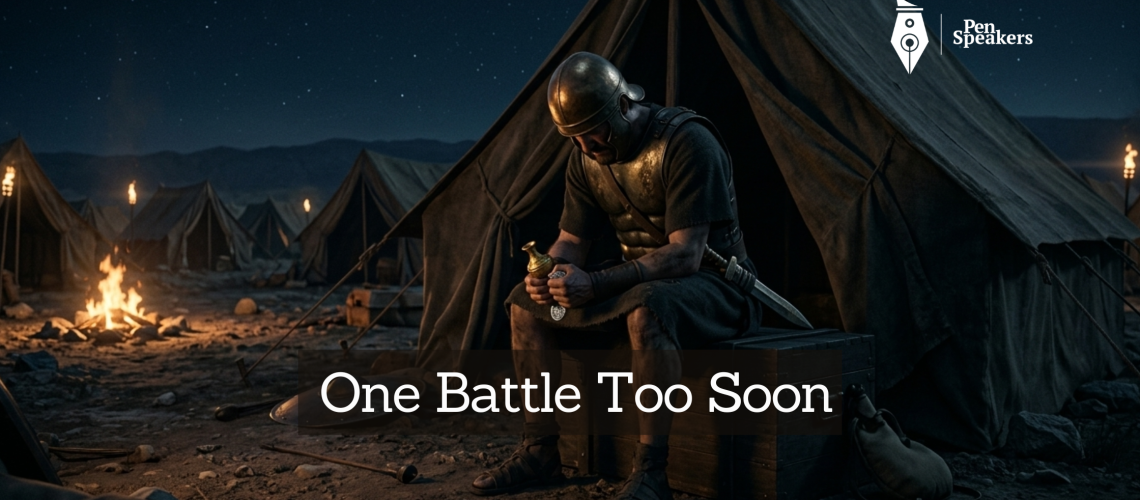
There is a detail in the book of Joshua that is easy to miss. But once you see it, it is absolutely heartbreaking.
You know the story of Achan. He took plunder from Jericho when God had commanded Israel to take nothing. He hid a beautiful robe from Babylonia, two hundred shekels of silver, and a gold bar under the floor of his tent. His sin was eventually uncovered, and he, his family, and everything he owned were destroyed.
That is the story we know. But here is what makes it truly tragic:
If Achan had waited just one more battle, literally one, he could have taken all the plunder he wanted.
At Jericho: “Keep away from the devoted things… All the silver and gold and the articles of bronze and iron are sacred to the LORD and must go into his treasury.” (Joshua 6:18–19)
At Ai, the very next battle: “You may carry off their plunder and livestock for yourselves.” (Joshua 8:2)
JOSHUA 6 & 8
One battle. That is all he had to wait.
Imagine Achan’s thoughts the morning Joshua announced the new instructions before Ai. Did his stomach drop? Did the weight of what he had done become suddenly unbearable? Did he realise in that moment that he had destroyed himself and his entire household for nothing, and that the very wealth he had stolen would have been given to him freely, had he simply trusted God’s timing?
“Achan didn’t die for taking what was forbidden. He died for taking prematurely what God was already planning to give.”
He was not the first, and not the last
Achan fits into a long and painful pattern running through Scripture: the people who reached one moment too early for what God intended to provide in the next.
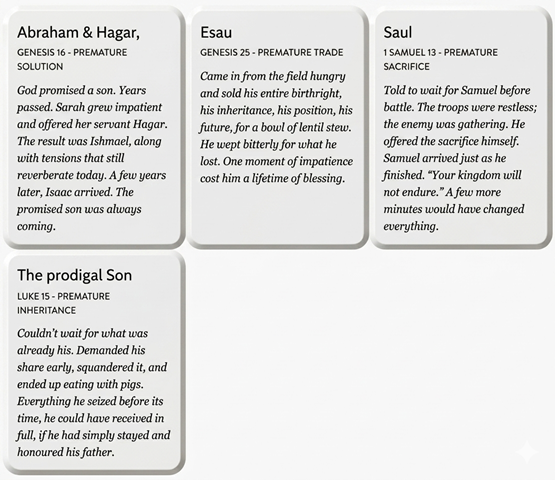
The pattern is consistent and devastating: the thing they grabbed prematurely was either already theirs, or something God intended to give. They did not lose by failing to reach. They lost by reaching too soon.
Why God’s timing feels impossible to trust
Achan standing inside Jericho, looking at that robe and that silver and that gold, is not a picture of a monster. He is a picture of us. And understanding why he reached for it is the beginning of understanding why we do the same.
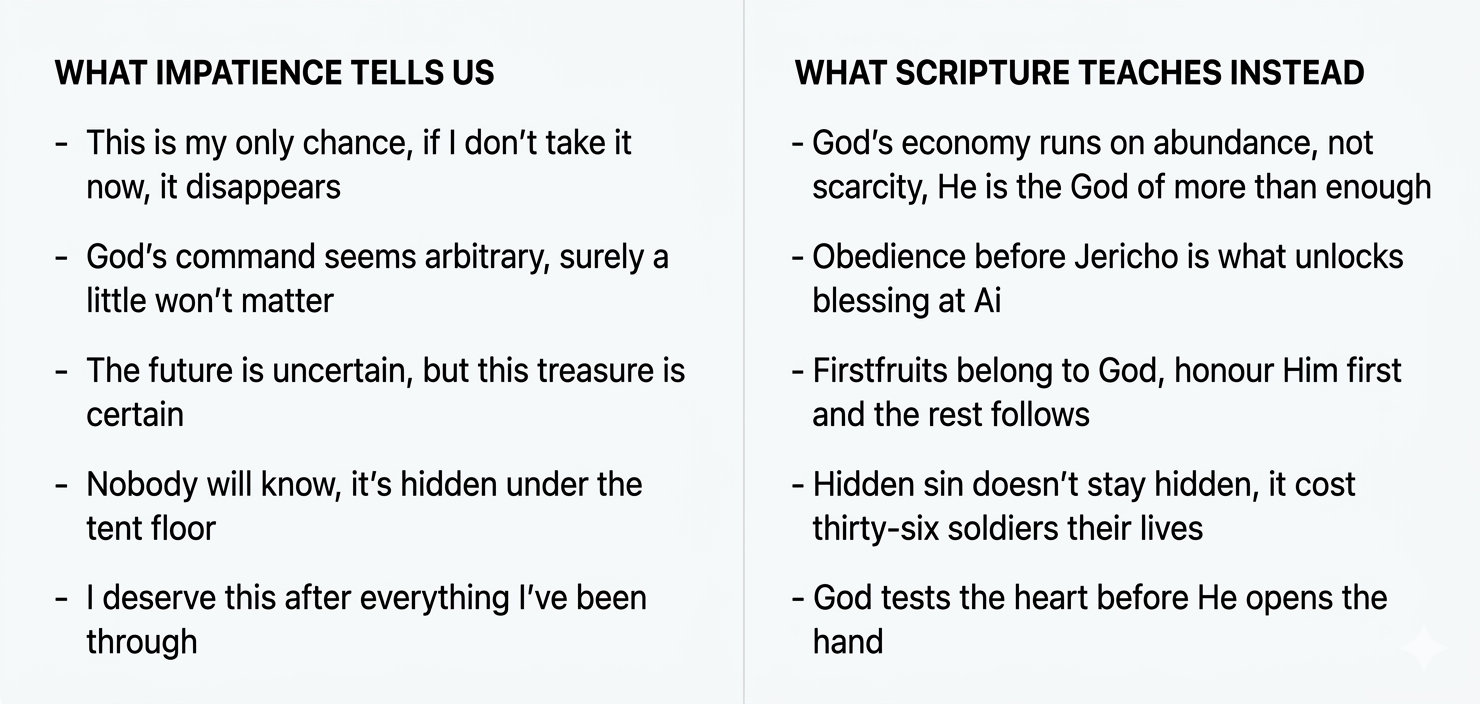
The tragedy of Achan’s sin is not only personal. Thirty-six Israelite soldiers died at Ai because of his impatience, soldiers who had no idea what he had done. They simply went into battle and lost, because one man could not wait one more day. Impatience does not stay contained. It radiates outward into families, teams, communities, and the people who trusted us with their futures.
The better story is possible
Achan’s story is a tragedy. It does not have to be yours.
Joseph waited thirteen years, through slavery, false accusation, and a prison cell, before God elevated him to second-in-command of Egypt. He could have seized power at any point through manipulation or compromise. He did not. And when God’s time came, he received far more than he could ever have taken on his own.
David was anointed king years before he wore the crown. He had multiple opportunities to kill Saul and claim the throne by force. He refused each one. “I will not touch the LORD’s anointed,” he said, and when God’s time finally arrived, the kingdom was established in his hands without blood on them.
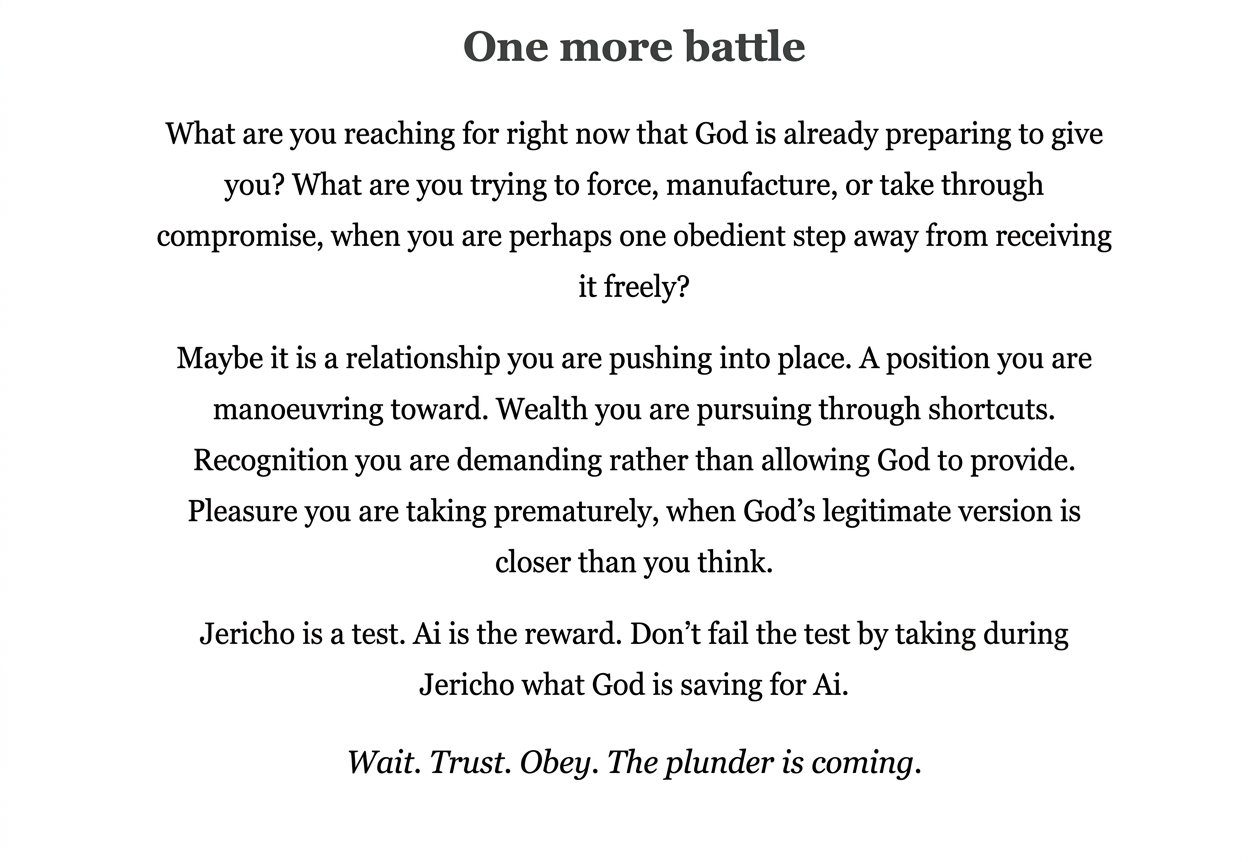
And Jesus, in the most costly act of waiting in human history, could have called down angels at any moment. He had the power to step down from the cross. He chose not to. He waited through suffering, through death, through the silence of Saturday, for the Father’s timing. And on the third day, the greatest reversal in history came to pass. The resurrection was the Ai after the Jericho of the cross.
“God isn’t withholding to be cruel. He is ordering events for maximum blessing, testing your heart before He opens His hand.”



2 thoughts on “One Battle Too Soon”
This is a powerful reminder that God’s delays are never His denials. Jesus endured the cross, the silence and the waiting because He trusted the Father’s perfect timing.
May we also learn to trust God when we cannot see what He is doing, knowing fully well that He is arranging everything for His Glory and our good in Christ Jesus’ name.
Thank you Mr Leke for this timely and encouraging reflection. More of Him in you, more wisom, more unction , more Grace in Christ Jesus’ name. Amen😇🙏
Our plans never work permanently. Being patient for His plans works best.