


….on silence, survival, and the things we keep tolerating.
There are situations you find yourself in and it just gives you so much joy to be part of it. The kind of moments that restore your faith in people and systems around us, even if just for a little while. The kind that makes you sit back and think, “okay… maybe things can actually change.”
I found myself in one of those situations during the week.
And funny enough, the way it unfolded gave me so much joy that I had to share it with a friend first before even thinking of writing it here. Now look at me, going around in circles, keeping you in suspense instead of just telling you the story. LOL. Forgive me. Let’s get into it.
As always, I have a story for you.
Story story…
There’s a route I take when I want to get to Ikeja from my area. The fare is usually ₦500. The buses we use are what we call Korope—the smaller version of danfo.
And just in case you’re not familiar, danfo buses are those popular yellow commercial buses you see everywhere in Lagos. They’re one of the cheapest ways to move around the city. A regular danfo usually carries about 14–18 passengers.
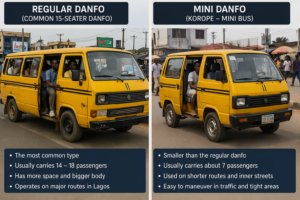
So in this case, I’ll call the Korope a mini danfo. Small bus. It usually takes about 7 passengers.
Back to gist.
I was rushing that day. Already late. I got to the park and heard one driver shouting, calling for “one more passenger.” In his words, “one more lucky passenger.” In my head, I was the lucky passenger.
I hurried toward the bus.
While still walking, I heard him clearly say, “₦700.” I paused mentally. ₦700? On this same route?
I assumed maybe the fare had increased again and I had missed the memo. So I kept moving.
As I was about to enter, someone nearby said, “But the other bus is taking ₦500.”
Ah.
That was all I needed.
I didn’t even sit properly. I stepped back immediately and moved to the other bus. And just like that, other passengers who had already entered the ₦700 bus also came down and joined the ₦500 one.
Now here’s where it got interesting.
The ₦500 driver saw what was happening and started begging us to go back to the ₦700 bus. He said he didn’t want “trouble” with the other driver and that he could even get reported to the union.
But nobody moved, we stood our ground.
Because honestly, it’s simple—we are customers. We decide what we want to pay for.
The ₦700 driver stood there, visibly irritated. He pointed toward the fuel station and started lamenting about fuel price increases. That everyone knows how expensive fuel is now, but we responded that the other driver buys fuel too.
Petrol currently sells for about ₦1,210 to ₦1,360 per litre in Lagos. It was after that increase that the fare was adjusted to ₦500, so why raise it again to ₦700?
Because that was the point.
If fuel increase was the reason, why was one bus still doing ₦500 while another jumped to ₦700 on the same route, same moment?
The driver who had called ₦500 fare, seeing that we passengers had spoken in unison, gladly got into his driver’s seat and drove off, while the other stood under the sun trying to get new passengers. Time gone. Effort wasted. Money not made.
As the bus moved, a guy inside—clearly both impressed and slightly fired up by how everything played out—spoke up. He said, “Yes, this is what protest should look like. This is how we should ordinarily come together as a people to speak against what works for us and what doesn’t.”
And I couldn’t agree more.
The thing about oppression is that it often starts with small tests.
You are poked, just to see what you can take at a time. You are pushed, and they wait to see if there will be a pushback. If there is none, they come back harder, bolder—and the cycle continues.
Even the other bus driver, while driving us, had to admit that greed was clearly at play with his colleague. Because one trip at ₦500 per passenger for 7 people is ₦3,500, and a return trip makes it ₦7,000.
If there had been no pushback, I wouldn’t be surprised if I went there again and heard the fare had been “reviewed” to ₦700. Why? Because they would have seen us accept it the first time and assumed it was fine—like we have extra money to spare, and it’s okay to take more.
But if I’m being honest, that kind of unity is rare.
Nigerians are often ruled by fear.
Fear of speaking up.
Fear of being the “problem.”
Fear of standing alone, even when you are right.
I’ve had my fair share of similar experiences too.
At a place I used to work, I remembered that in my work contract, I was entitled to annual leave, just like my other colleagues. But I noticed a pattern—you might never actually get your leave. And me, as much as I love work and I’m devoted to it, I also deeply value my rest time; the time to pause, recover, and reset.
https://penspeakers.com/i-am-tired/
I tried to find out from people who had been there longer, but they were all quite hush-hush about it. So one day, I decided I was going to ask for my leave, and that was when I fully saw the issue. It was with the owner of the establishment. Getting leave there was almost like a battle. Different tactics were used—emails not replied on time, delays in response, frustrating your follow-ups, and all sorts. But I told myself, I will get my leave.
I spoke to my colleagues about it, and we agreed we would raise it in our general meeting with the General Manager. That was settled.
We got to the meeting, and I initiated the conversation. The General Manager dismissed it like it was nothing. I went back to it again, and the boss got visibly upset. I looked around for my colleagues to support the point.
Dear gentle reader… I was met with cricket sounds.
As I recall it now, I can laugh, but back then it was painful. I felt betrayed.
I got home and ranted to a friend of mine who was in a managerial role in another organisation. That person then schooled me on office politics.
I was told to always speak for myself. That the best I could do was encourage others to speak for themselves, but I should never position myself as the “ring leader” speaking for everyone.
I questioned that thinking. But I was reminded that it is an unfortunate reality—people can leave you to face consequences alone.
So I tried a different approach. I handled it individually.
And guess what? I got my leave in a week!
And interestingly, my colleagues also learned from it and followed the same path afterward.
That’s when something clicked for me.
Sometimes, someone has to go first. Not because they are fearless, but because change often needs a starting point.
And yes, sometimes you will stand alone in that starting moment.
Silence doesn’t fix broken systems, avoidance doesn’t fix unfairness and fear just keeps things comfortable for the wrong side.
Not to sound cliché, but sometimes you really do have to be the change you want to see. And maybe, just maybe, others will eventually follow.
One of my colleagues then even recently reminded me of that period and we laughed about it. We might have left that organisation, but at least that lesson stuck with me/us.
The thing is, as a Nigerian, I’ve noticed we are often ruled by fear—fear of speaking up, fear of being singled out, fear of being seen as “problematic.” And trust me, I understand it.
Nobody wants to be the odd one out, even when they are right.
And this is exactly what thrives on silence—systems that are unfair, exploitative, or simply illogical. They survive because people don’t question them.
We say things like, “it’s just a 100 naira increase,” or “it’s just leave,” or “it’s not that serious.” But those “just” moments add up until they become something much bigger than we can ignore.
Even a child around me, when I was telling the story to my friend, said, “Aunty Anike, it’s just 200 naira.” And I had to gently explain that it is never really “just.” Because little increments, little compromises, little silences—they accumulate.
Before you know it, you’re stretched beyond what you planned for, simply because it didn’t look like much at first.
That’s how it starts.
Just small increase…
Just small silence….
Just manage it….
Until it becomes something bigger that nobody can control anymore.
We cannot afford to keep watching things unfold passively. We’ve done that for too long. Played it safe for too long.
We complain a lot.
About the economy.
About leadership.
About systems.
But we rarely act beyond complaints and maybe that’s the real issue. Not just what is happening but what we are willing to accept repeatedly without question.
I’m not saying rebellion for everything. I’m saying awareness. Questioning.
Speaking up when something is clearly off.
Even if your voice shakes.
Even if you’re the only one.
Because sometimes, that one voice is what gives others permission to speak.
We owe it to ourselves, and even to the people coming after us, to question things. To speak up when something doesn’t sit right. Not to be bullied into silence.
I look forward to a time when we do more than complain—when we ask questions, when we demand clarity, when we say no to injustice even when it is uncomfortable.
Sometimes it starts with people saying, “No, this doesn’t make sense,” and walking away.
And maybe that’s where we need to grow as people, not just in complaining. But in courage.
It starts small. From homes. Workplaces. Schools. Churches. Then it spreads wider, even into the different arms of government.

So much needs to be questioned. So much needs to be challenged.
But the real question is—will we be bold enough to?
Think about it.
Ok bye.



2 thoughts on “Maybe we are cowards!”
Oh I loved this read, I’m greatly encouraged
Together we stand divided we fall. But that Stand often starts with 1 person.
I stand. We stand.