

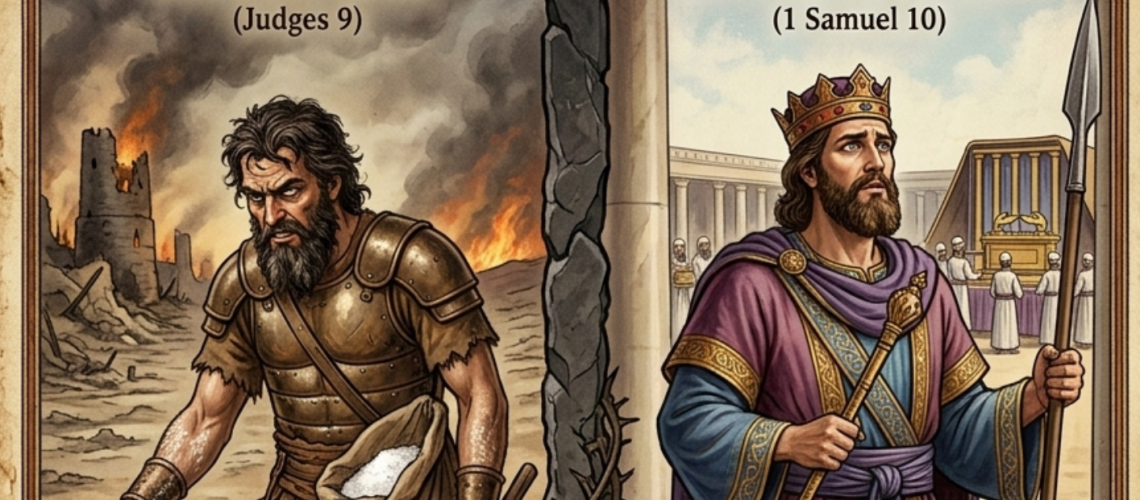
Ask anyone, “Who was Israel’s first king?” and they’ll answer, “Saul.”
But flip back to Judges 9, and you’ll find someone who was crowned king decades before Saul: Abimelech, son of Gideon.
He had a crown. He ruled for three years. He was called “king.”
So why doesn’t he count?
The answer reveals something profound about the difference between seizing power and receiving authority, between wearing a crown and bearing legitimacy, between having a title and having God’s anointing.
Abimelech had the crown. But he didn’t have the kingdom.
The Violent Path to Power
After Gideon died, his son Abimelech went to his mother’s relatives in Shechem with a proposition: which is better—to have seventy of Gideon’s sons rule over you, or just one man who’s your own flesh and blood?
The men of Shechem gave him seventy shekels of silver from the temple of Baal-Berith. Abimelech used it to hire thugs who became his followers. Then he went to his father’s home and murdered his seventy brothers on one stone. Only Jotham, the youngest, escaped by hiding.
After this massacre, the citizens of Shechem crowned Abimelech king.
Abimelech’s crown was forged in fratricide.
The Parable of the Thornbush
Jotham climbed Mount Gerizim and shouted a parable to the people who’d crowned Abimelech:
The trees went looking for a king. They asked the olive tree, but it refused—too busy producing oil. They asked the fig tree, but it refused—too busy bearing fruit. They asked the vine, but it refused—too busy making wine.
Finally, they asked the thornbush. And the thornbush said yes.
The meaning was clear: The worthy refused to be king. The worthless accepted.
The olive, fig, and vine were productive, fruitful, useful. But the thornbush? It produces nothing. It’s useless for shade. It’s good for nothing except catching fire and spreading destruction.
That was Abimelech: a thornbush pretending to be a cedar.
Jotham prophesied that fire would consume them all. And it did.
Three Years of Illegitimate Rule
Judges 9:22 records that “Abimelech had governed Israel three years”—so he did have national administrative control. This wasn’t merely regional; the Bible itself says he governed Israel.
Yet despite this, Scripture still doesn’t count him as Israel’s first king. The text uses “governed” rather than “ruled” or “reigned”—a subtle but significant distinction. He had administrative control, but not legitimate authority from God.
And even that didn’t last long.
God stirred up hostility between Abimelech and Shechem. The city that crowned him turned against him. God Himself opposed Abimelech’s kingship.
When Shechem rebelled, Abimelech destroyed the city, killed everyone, and salted the ground. About a thousand people who’d taken refuge in a tower were burned alive.
Then he moved to Thebez, another rebellious city. He approached the tower to burn it as he’d done at Shechem.
But a woman dropped a millstone on his head and cracked his skull.
In his dying moments, Abimelech called to his armour-bearer: “Draw your sword and kill me, so they can’t say a woman killed him.”
He died as he lived—violent, prideful, illegitimate.
The narrator concludes: “Thus God repaid the wickedness that Abimelek had done to his father by murdering his seventy brothers.”
Why Abimelech Doesn’t Count
So why doesn’t Abimelech count as Israel’s first king, despite ruling Israel for three years?
- He Was Self-Appointed, Not God-Appointed
Abimelech crowned himself through violence and political manipulation.
Saul was anointed by God through the prophet Samuel.
When Samuel anointed Saul, he said, “Has not the LORD anointed you ruler over his inheritance?” God confirmed Saul’s kingship through signs, through casting lots, and through military victory.
Abimelech had no such confirmation. No prophet anointed him. No divine signs validated him. No God-given victory legitimised him.
He took the crown. He wasn’t given it.
- He Murdered His Way to the Throne
Seventy brothers murdered on one stone to eliminate competition. That’s not kingship—that’s fratricide with a crown.
David was anointed years before taking the throne. During that time, Saul tried repeatedly to kill him. David had multiple opportunities to kill Saul and seize power.
But he refused. “I will not lay a hand on the LORD’s anointed,” he said.
David understood: a throne seized through violence is not a throne blessed by God.
- He Ruled Through Fear, Not God’s Authority
Abimelech hired “reckless scoundrels” as followers. He maintained power through violence and intimidation. When cities rebelled, he destroyed them completely—salting ground, burning people alive.
This is tyranny, not kingship.
- He Never Ruled All Israel Legitimately
Yes, verse 22 says he “governed Israel three years,” so he had national administrative control. But there’s a difference between having control and having legitimate authority.
His rule was:
- Gained through violence and murder
- Maintained through hired thugs and fear
- Opposed by God Himself
- Contested by his own supporters
- Never validated by prophetic anointing
Saul, by contrast, was proclaimed king over all Israel with proper anointing, prophetic validation, and genuine consent of the tribes who united under his leadership.
- God Actively Opposed His Reign
“God stirred up animosity between Abimelek and the citizens of Shechem.” God didn’t just withhold blessing—He actively worked against Abimelech’s kingship as judgement.
A king whom God opposes is no king at all.
- His Reign Ended in Disgrace
Legitimate kings leave legacies. David’s kingdom lasted. Solomon’s wisdom was remembered. Even Saul established the institution of monarchy.
Abimelech left nothing but destruction. After three years, he was dead—killed by a woman with a millstone. No dynasty. No succession. No legacy. Just fire, blood, and a fulfilled curse.
The Pattern: Legitimacy Over Chronology
The Bible is filled with examples where the technical first isn’t the legitimate first:
- Ishmael was Abraham’s firstborn, but Isaac was the son of promise.
- Esau was the firstborn, but Jacob received the birthright.
- Absalom crowned himself king briefly, but Solomon was the legitimate successor.
- Abimelech wore a crown first, but Saul was the first legitimate king.
The pattern is consistent: God honours legitimacy, not chronology. He recognises authority He grants, not power people seize.
What Scripture Says
When Scripture refers to Israel’s first king, it consistently identifies Saul, not Abimelech.
Acts 13:21 says, “Then the people asked for a king, and he gave them Saul son of Kish.”
The entire narrative of 1 Samuel 10-12 presents Saul’s anointing as the beginning of monarchy in Israel, not the continuation of an existing institution.
Scripture treats Abimelech as an illegitimate interruption, not a legitimate beginning.
Modern Applications
Abimelech’s story speaks to our own time:
In leadership: Position doesn’t equal authority. You can have the title without genuine respect or trust. Real authority is granted, not seized.
In ministry: You can call yourself “pastor” or “prophet” without God’s calling. You can build a platform without God’s anointing. But if God hasn’t appointed you, your ministry is just a thornbush with a title.
In any sphere: Legitimate authority comes from God and is recognised by others. Illegitimate power is seized by force and maintained through fear.
The question that matters: Do you have a title, or do you have authority?
Why Saul Counts and Abimelech Doesn’t
Saul was anointed by God. Abimelech crowned himself.
Saul united Israel. Abimelech divided it.
Saul established an institution. Abimelech created chaos.
Saul’s kingdom continued through David. Abimelech’s reign ended in flames.
God appointed Saul. God opposed Abimelech.
Yes, Abimelech came first chronologically and even governed Israel for three years. But chronology doesn’t determine legitimacy.
The king who doesn’t count teaches us that having a crown doesn’t make you a king. God’s appointment does.
Abimelech wore a crown for three years and was forgotten.
Saul was anointed by God and started a dynasty that produced David, Solomon, and ultimately, Jesus Christ.
One was a thornbush. The other was the beginning of a kingdom.
Legitimacy matters more than chronology. God’s anointing matters more than self-appointment. Authority matters more than power.
Abimelech had the title. But he doesn’t count.
Because a crown seized through violence is just a hat stained with blood.
And God doesn’t recognise kings He didn’t appoint—no matter how loudly they demand to be called “Your Majesty.”



1 thought on “The King Who Doesn’t Count”
Hmmmmmm! An eye opener. This is very interesting to read. More wisdom in Christ Jesus’ name and may God bless you pen bro.