


I was reading Numbers 19 when I hit a wall. Not a wall of confusion, but a wall of conviction, the kind that stops you mid-chapter and forces you to sit with what you’ve just read.
The passage describes one of the most unusual rituals in all of Torah: the red heifer. A rare, unblemished red cow was to be slaughtered outside the camp, burned entirely, and its ashes mixed with water. That water, called the water of purification, would then be used to cleanse anyone who had become ceremonially unclean through contact with a dead body.
Simple enough. But here is where the text stopped me cold.
Everyone involved in preparing the purification water became ceremonially unclean themselves.
“Then the priest shall wash his clothes… and shall be unclean until evening.” (v. 7) “The one who burns it shall wash his clothes… and shall be unclean until evening.” (v. 8) “Then a man who is clean shall gather up the ashes… He shall be unclean until evening.” (v. 10) “He who sprinkles the water of purification shall wash his clothes; and he who touches the water of purification shall be unclean until evening.” (v. 21)
Numbers 19:7–10, 21
Read that again. The unclean person who receives the water becomes clean. But the clean people who prepare and apply it become unclean. Those who free others from contamination get contaminated themselves.
This is not a scribal error. This is not an oversight. It is, as I came to understand, entirely by design, and it contains one of the most arresting theological and practical truths in all of Scripture.
“The one who provides cleansing bears the contamination. The one who sets others free pays the price of freedom.”
What the paradox was always pointing toward
This Levitical ritual does not stand alone. It is a shadow, a shape cast centuries earlier by something that would only become fully visible at Calvary.
“For He made Him who knew no sin to be sin for us, that we might become the righteousness of God in Him.”
2 Corinthians 5:21
Jesus, the only truly clean one, became unclean so that those contaminated by sin could become clean. He bore our contamination. He stepped into our defilement. He took on what we carried so that we could be handed what He carried.
“Surely He has borne our griefs and carried our sorrows… He was wounded for our transgressions, He was bruised for our iniquities; the chastisement for our peace was upon Him, and by His stripes we are healed.”
Isaiah 53:4–5
The Healer was wounded. The Pure One became sin. The Life-Giver died. The red heifer ritual encoded this reality centuries before it happened, and every priest who walked away from that ceremony unclean was living out, in miniature, the cosmic exchange that would one day occur on a hill outside Jerusalem.
But as I sat with this truth, a second and far more uncomfortable realisation emerged. This isn’t only theology. This is the daily experience of anyone who chooses to serve.
When the paradox becomes personal
Those who serve others often become “contaminated” in the process. Not morally, but experientially. They absorb cost. They carry weight. They give from reserves that do not automatically replenish, and the people closest to them, the ones who need them most, often receive what is left after everyone else has been served.
We don’t talk about this enough in ministry and leadership circles. We talk about calling. We talk about sacrifice. We talk about the fruit. We rarely talk about the priest who walked away from the ceremony unclean.
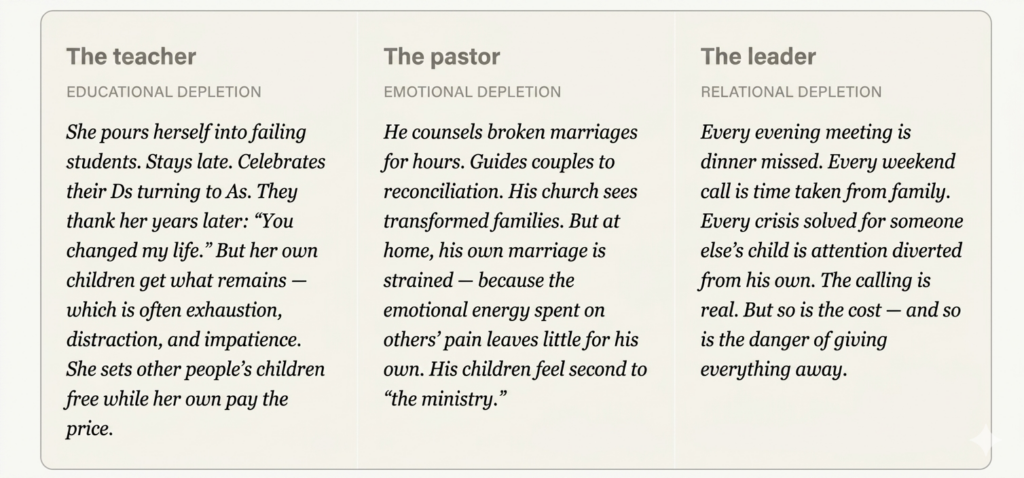
This pattern runs deep in Scripture too. Moses led Israel for forty years, interceding for them, bearing their complaints, standing between them and God’s judgment. The result?
“I am not able to bear all these people alone, because the burden is too heavy for me. If You treat me like this, please kill me here and now.”
Numbers 11:14–15
Moses, the deliverer, wanted to die. Not because the mission was wrong, but because he was carrying it alone, with no rhythm of restoration. Paul described his own ministry as being “poured out as a drink offering”, completely spent, nothing remaining. Even Jesus, fully God, pulled back deliberately. After seasons of intense ministry, He withdrew. He slept. He ate with friends. He said, plainly, “Come aside by yourselves to a deserted place and rest a while”, because the crowds were so constant, Mark tells us, they did not even have time to eat.
If Jesus needed margin, so do you.
“You are not infinite. Every hour given to someone else is an hour not given to someone else. This is not selfishness. This is reality.”
The dangerous lie leaders believe
Here is the lie, and it sounds so spiritual that most leaders never notice it is a lie at all:
“If I am truly sacrificial, truly loving, truly servant-hearted, I should give everything to everyone who needs it.”
It sounds noble. It has the shape of faithfulness. But it violates three realities that Scripture takes seriously.
First, it ignores stewardship. God gave you specific people to care for first, your spouse, your children, your own soul and body. Paul is unambiguous: “If anyone does not provide for his own, and especially for those of his household, he has denied the faith and is worse than an unbeliever” (1 Timothy 5:8). To neglect your primary responsibility in service of secondary ones is not sacrifice. It is misplaced priority dressed in spiritual language.
 Second, it leads to burnout, and burnout is not a badge of honour. It is a warning sign that the rhythm God designed has been violated. Elijah, after the greatest victory of his ministry at Mount Carmel, collapsed under a tree and asked God to let him die. The ministry had consumed him. God’s response was not a lecture. It was bread, water, and sleep, twice, before He said another word.
Third, it models something destructive to the next generation. When leaders burn out spectacularly, they teach those watching that exhaustion is the mark of faithfulness, that neglecting family is the cost of calling, that boundaries are selfishness. And the next generation repeats the pattern.
Better to serve at seventy percent capacity for forty years than at one hundred and ten percent for five years and then collapse.
Strategic contamination: the rhythm God designed
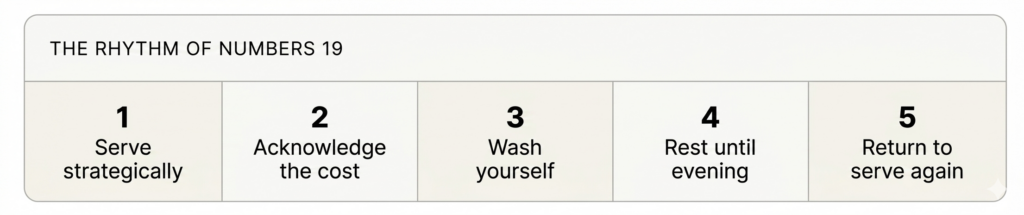
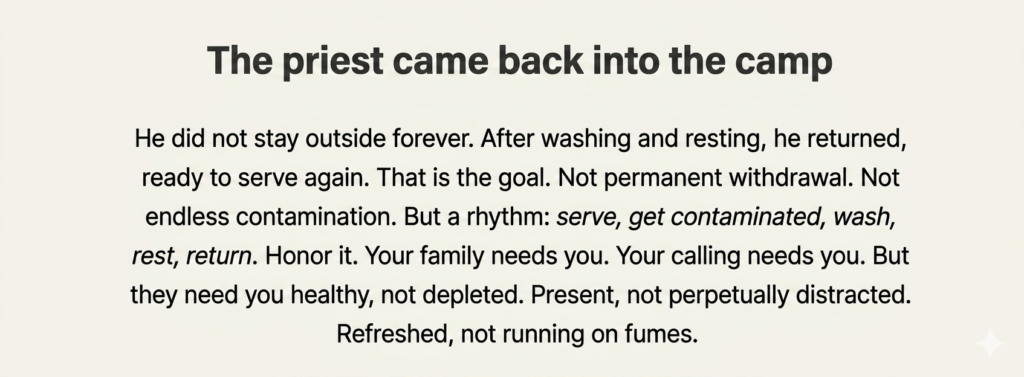
Return to Numbers 19, because the paradox contains its own solution. The contamination was necessary. The priest had to become unclean to do the work. But notice something critical: he did not stay unclean. The text is explicit.
“Then the priest shall wash his clothes and bathe in water, and afterward he may come into the camp; but the priest shall be unclean until evening.”
Numbers 19:7
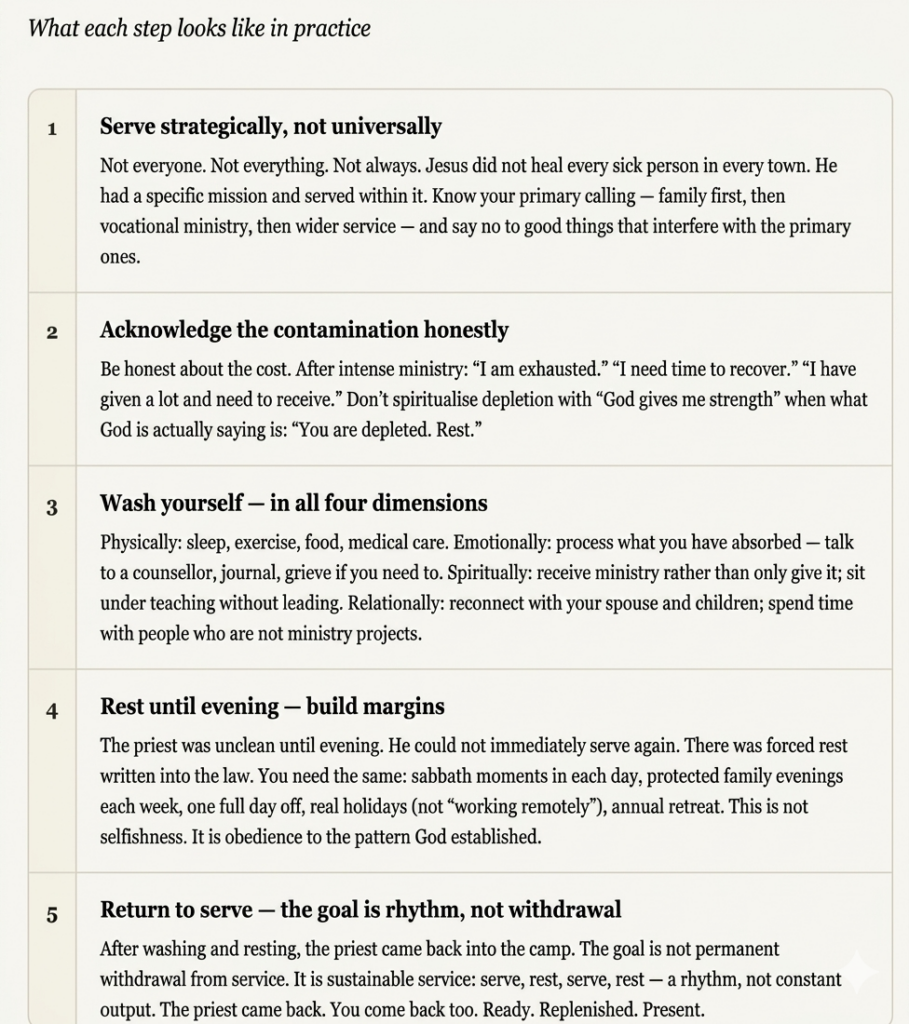
There was a sequence embedded in the ritual, not just service, but a full cycle of serve, acknowledge the cost, cleanse, rest, and return. This is the model for sustainable leadership.
What each step looks like in practice
If you are reading this on empty
Perhaps you picked up this piece already depleted. You have been giving to everyone, and your own family, your primary stewardship, is struggling. You feel guilty for wanting rest. You wonder if the desire to pull back means something is wrong with your commitment.
Here is what the red heifer paradox is saying to you directly: the contamination is not a sign that you failed. It is a sign that you served. The cost is real. The depletion is real. But it was never meant to be permanent, and it was never meant to be borne without the washing that follows.
Serving your family is ministry. Not the secondary kind, the primary kind. If you are succeeding in your public role and failing at home, you are failing at your first calling. And rest is not rebellion. When you refuse to rest, you are not being more faithful than God asked. You are being disobedient to a rhythm He wove into creation before He ever asked anyone to serve.



5 thoughts on “The Paradox of the Red Heifer”
Thank you for this lovely publication,to think I had so many questions while reading this article on how to balance life in the area of career ,ministry ,leadership and all ,the answers were embedded in the latter part .and I could relate this to everyday living and life (realistically ) A standing ovation
I am glad your questions were answered while reading, keep engaging, share this article generously with those in your circle and you will easily be a minister and the “ovation” in heaven for you will be loud.
This is sooooooo deeply profound! Thank you for this, sir
You’re welcome Phemie. And thank you for sharing.
Hmmmm word!
“Very insightful post bro.🙏
It explains why helpers also need protection, wisdom, and spiritual covering while helping others. Deep lesson indeed.” My of His Grace upon you. 😇