

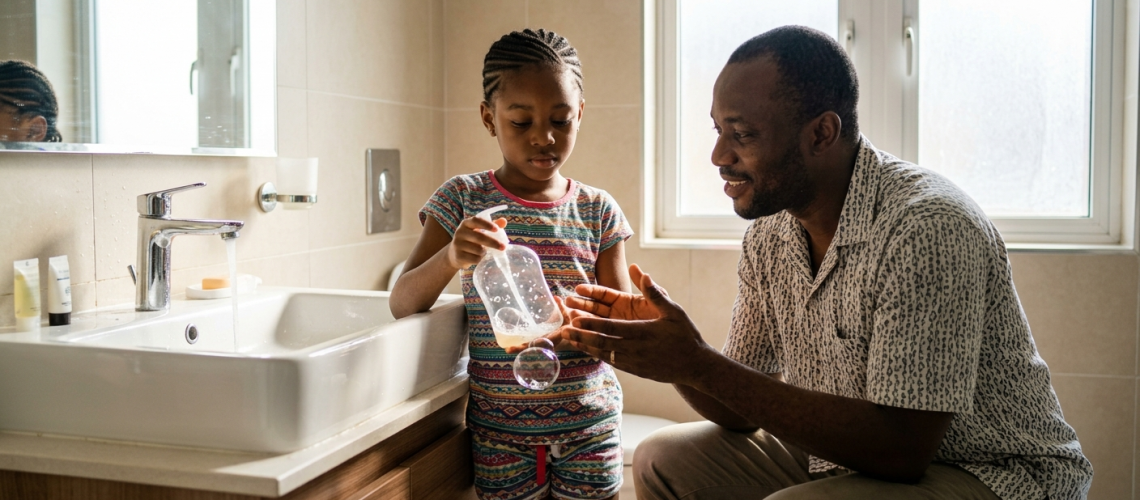
It started with a bottle of liquid soap.
Our daughter had used an entire bottle in three days. Not because she needed it. Not because she had shared it generously with anyone. Simply because it was there, and she had not been taught to think otherwise.
What followed was a conversation I had not planned to have that morning, but one I am glad we had. Because as we talked, I realised that the issue was not really about liquid soap at all. It was about three fundamental ways of relating to resources, to money, to what we have been given, that will shape how our daughter handles abundance and scarcity for the rest of her life.
I want to share all three here, because I suspect the liquid soap is not the only place they are showing up.
First: The Miser’s Mindset
The miser holds on to everything.
Not because they do not have enough, but because letting go of anything feels like a loss they cannot afford. The miser hoards. The miser keeps. The miser calculates every act of generosity against what it will cost them personally, and more often than not, decides that the cost is too high.
Children can develop a miser’s mindset early, and it does not always look the way we expect. It looks like a child who will not share her snacks with a friend, not because she is hungry, but because she does not want less. It looks like a teenager who accumulates gifts and resources but never thinks to pass anything on, never experiences the pleasure of giving, never learns that generosity does not diminish you.
The miser mindset, when it takes root, produces adults who are difficult to work with, difficult to live with, and strangely, rarely as secure as they hoped their holding on would make them.
Abundance kept entirely to yourself has a way of making you smaller, not larger.
Second: The Extravagance Mindset
At the opposite end sits extravagance, and this is where our daughter was sitting that morning.
The extravagance mindset wastes what it has been given. Not always out of malice or selfishness, often simply out of carelessness. Things are used without thought, consumed without appreciation, discarded before their usefulness is exhausted.
The child who uses an entire bottle of liquid soap in three days is not a bad child. She is an untaught child. Nobody has yet helped her connect the resource in her hand to the effort it took to put it there, to the family budget it came from, to the child somewhere who does not have access to it at all.
Extravagance is not only a financial problem. It is a posture towards life. The extravagant person does not think carefully about what they have been entrusted with. They consume first and consider later, if they consider at all. And when resources run short, they are genuinely surprised, because abundance had always felt like a permanent condition rather than a gift to be stewarded.
We live in a world that actively markets the extravagance mindset to our children from the moment they can hold a screen. More, faster, newer, again. The default setting, if we do not deliberately set another one, will be extravagance.
Third: Prudence
Prudence is the mindset we are aiming for, and it sits in the tension between the other two.
The prudent person uses what they have thoughtfully. Not clutching it so tightly that they cannot give, and not spending it so freely that nothing remains for the purposes it was meant to serve.
Prudence thinks before consuming. It asks: do I need this much? Can this be passed on when I am done with it? Is there a way to use this that leaves something for someone else?
Prudence is not the same as stinginess. The prudent person can be extraordinarily generous, precisely because they have been careful enough with their resources to have something left to give. They treat what they have been given gently enough that it retains its value, long enough to serve more than one purpose.
I explained it to our daughter this way: when God blesses us with more than we need, it is not so that we can have more than we need. It is so that we can share what we have with others. The abundance is not ours to consume. It is ours to steward.
That is a different relationship with resources entirely.
The Balance Worth Teaching
When I laid out these three mindsets for our daughter that morning, I was careful to frame them not as rules but as ways of seeing.
I told her: we want you to have an abundance mindset. We want you to know that God is a generous God, that scarcity is not His intention for our family, that there is enough.
But abundance does not mean unlimited. It does not mean thoughtless. It does not mean that because there is more where that came from, it does not matter how you treat what is already in your hands.
The abundance mindset and the prudence mindset are not in conflict. In fact, they belong together. It is precisely because God has been generous with us that we take what He has given us seriously. We use it well. We treat it gently. We hold it loosely enough to share, and carefully enough that there is something worth sharing.
That is the balance. And it is not instinctive in children. It has to be taught, repeatedly, in small and ordinary moments like a bottle of liquid soap and a conversation that runs longer than planned.
A Word to Parents
We tend to have the money conversation with our children when money is the subject. When they want something expensive. When they have wasted something valuable. When a financial lesson is obvious enough that it cannot be avoided.
But the formation of a child’s mindset around resources does not happen in those moments. It happens in the small, daily, unguarded moments: how they use their snacks, how they treat their belongings, whether they think to share without being told, whether they notice when something runs out and wonder where it came from.
Those moments are the curriculum. And they are always running, whether we are teaching into them or not.
The question is not whether your child is learning a mindset about money and resources. They already are. The question is which of the three they are learning, and whether you are the one doing the teaching.



2 thoughts on “The Three Mindsets Every Child Needs to Learn About Money and Resources”
So true Mr Leke!😄👍.
Our everyday moments are often the most powerful teachers. Children learn how to value, manage, share and appreciate resources long before we sit them down for a conversation about money. What they consistently see, hear and practise becomes their mindset. What a very insightful and timely piece. May God bless your wisdom dearest bro.
This is such a powerful and timely perspective. ❤️ The liquid soap may have been the starting point, but the lesson goes far beyond soap; it speaks to how we teach children to relate to money, possessions, opportunities, and even the blessings they have been given.
I particularly love the distinction between abundance and extravagance. Abundance is knowing there is enough; prudence is knowing how to steward what you have. What a beautiful balance to teach our children.
Thank you for sharing this, Sir. So many of these little everyday moments are indeed the curriculum, and this is a reminder that we have to be intentional about what we are teaching through them. 🙏🏽