


“Give me some water,” he said. “I’m thirsty.” Sisera was exhausted, fleeing a catastrophic military defeat, running for his life. He asked for the minimum. What he received was far more generous, and far more deadly.
Sisera was the commander of King Jabin’s army, the man who had cruelly oppressed Israel for twenty years with 900 iron chariots, the ancient equivalent of tanks. Then God raised up Deborah, a prophetess and judge, who summoned Barak to lead Israel’s forces against him. Before the battle, Deborah issued a striking prophecy: the honour of the victory would not go to Barak but to a woman.
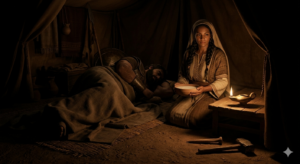 The battle was miraculous. God threw Sisera’s forces into confusion. The iron chariots became useless, possibly mired in the sudden flooding of the river Kishon. Sisera’s entire army was routed and he, the great commander, abandoned his chariot and fled on foot, ending up at the tent of Jael, wife of Heber the Kenite.
He had reason to feel safe there. The Kenites had a treaty with King Jabin, Sisera’s employer. Jael herself came out to meet him.“Come in, my lord. Come right in. Don’t be afraid.”
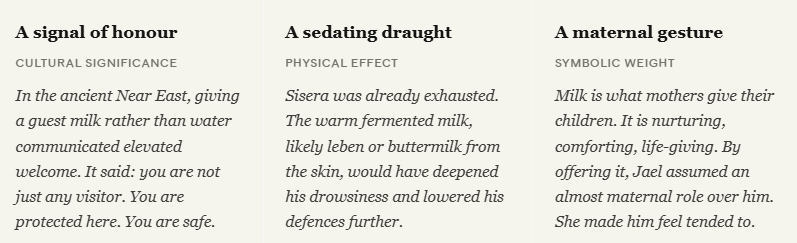
He asked for water. She gave him milk.
He came in. She covered him with a blanket. Then he made his request: water, just enough to survive, the most basic ask of a desperate man. And Jael exceeded it.
“She opened a skin of milk, gave him a drink, and covered him up.”
Judges 4:19
That single upgrade, from water to milk, was not merely generous. It was strategic, layered with meaning that a man in Sisera’s world would have understood immediately.
Sisera felt so safe that he gave her instructions: stand in the doorway, and if anyone asks whether someone is inside, say no. He placed his life entirely in her hands, lay down, and fell into a deep and trusting sleep.
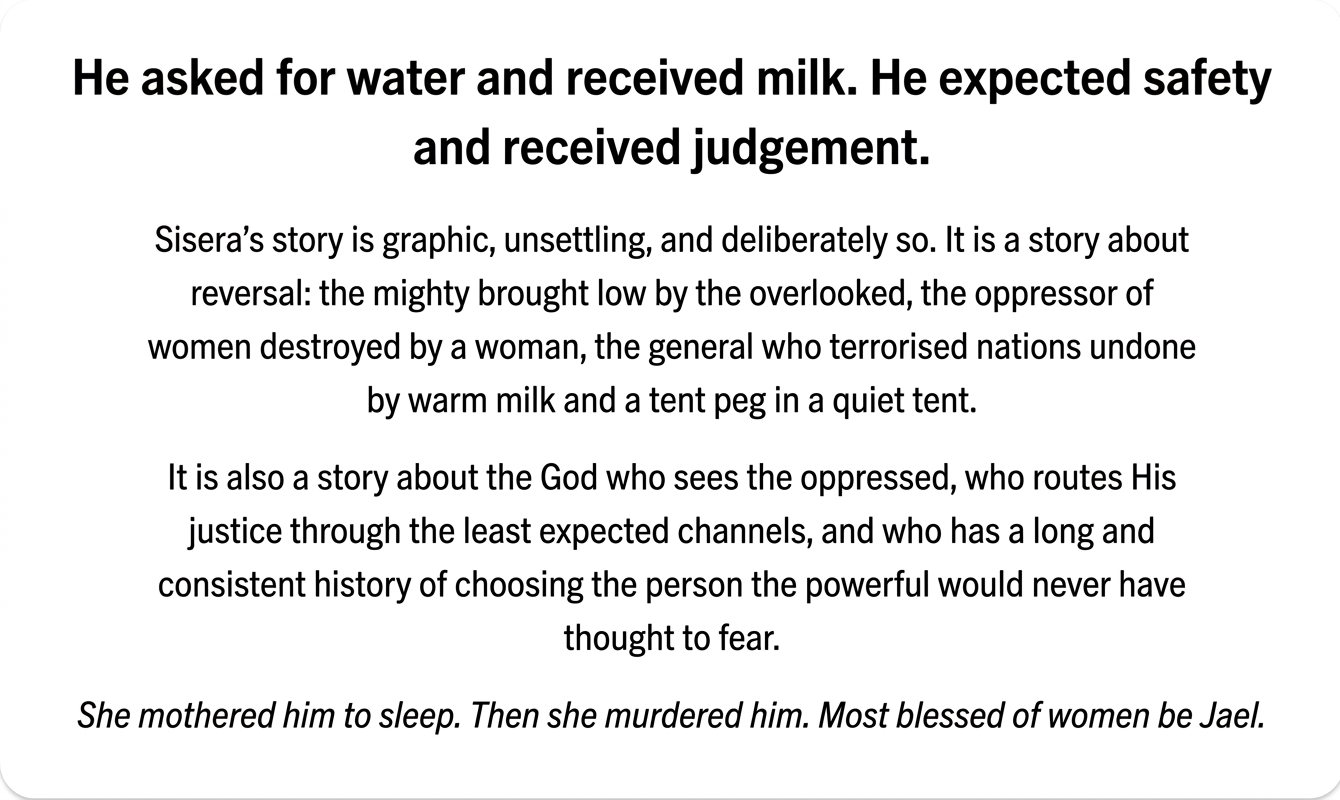
She mothered him to sleep. Then she murdered him.
“But Jael, Heber’s wife, picked up a tent peg and a hammer and went quietly to him while he lay fast asleep, exhausted. She drove the peg through his temple into the ground, and he died.”
Judges 4:21
“The man with 900 iron chariots was not defeated in open battle. He was defeated by a woman in a tent, with a peg and a hammer, lulled to his end by a bowl of warm milk.”
Most blessed of women: the song and its haunting coda
Judges 5 records Deborah and Barak’s victory song. Jael is celebrated in vivid, triumphant terms, called “most blessed of tent-dwelling women.” The song describes the moment in deliberate, almost hypnotic repetition: “At her feet he sank, he fell; there he lay. At her feet he sank, he fell; where he sank, there he fell, dead.” The mighty Sisera, who had made nations tremble, fell at the feet of a woman in a tent.
But then the song shifts, and this is where the text becomes genuinely devastating. It moves from Jael to another woman entirely: Sisera’s mother, peering through the lattice of her window, waiting for her son’s chariot to appear on the horizon.
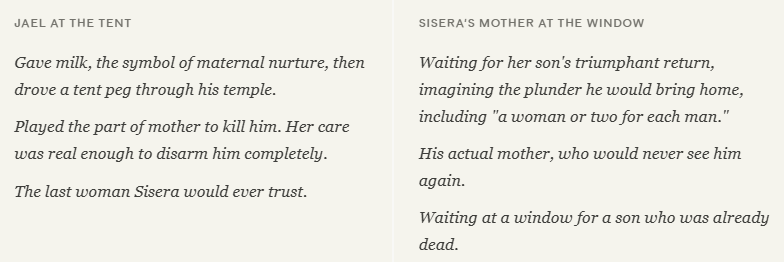
The contrast is intentional and heartbreaking. One woman’s maternal gesture was calculated deception. The other woman’s maternal hope was destined for grief. And there is a bitter irony threaded through it: Sisera’s mother imagined her son returning with women as plunder, women as objects to be taken and distributed among the victors. But it was a woman who ensured he would never return at all. The oppressor of women was destroyed by a woman. The one whose mother pictured him seizing “a woman or two” was taken down by one woman with a tent peg.
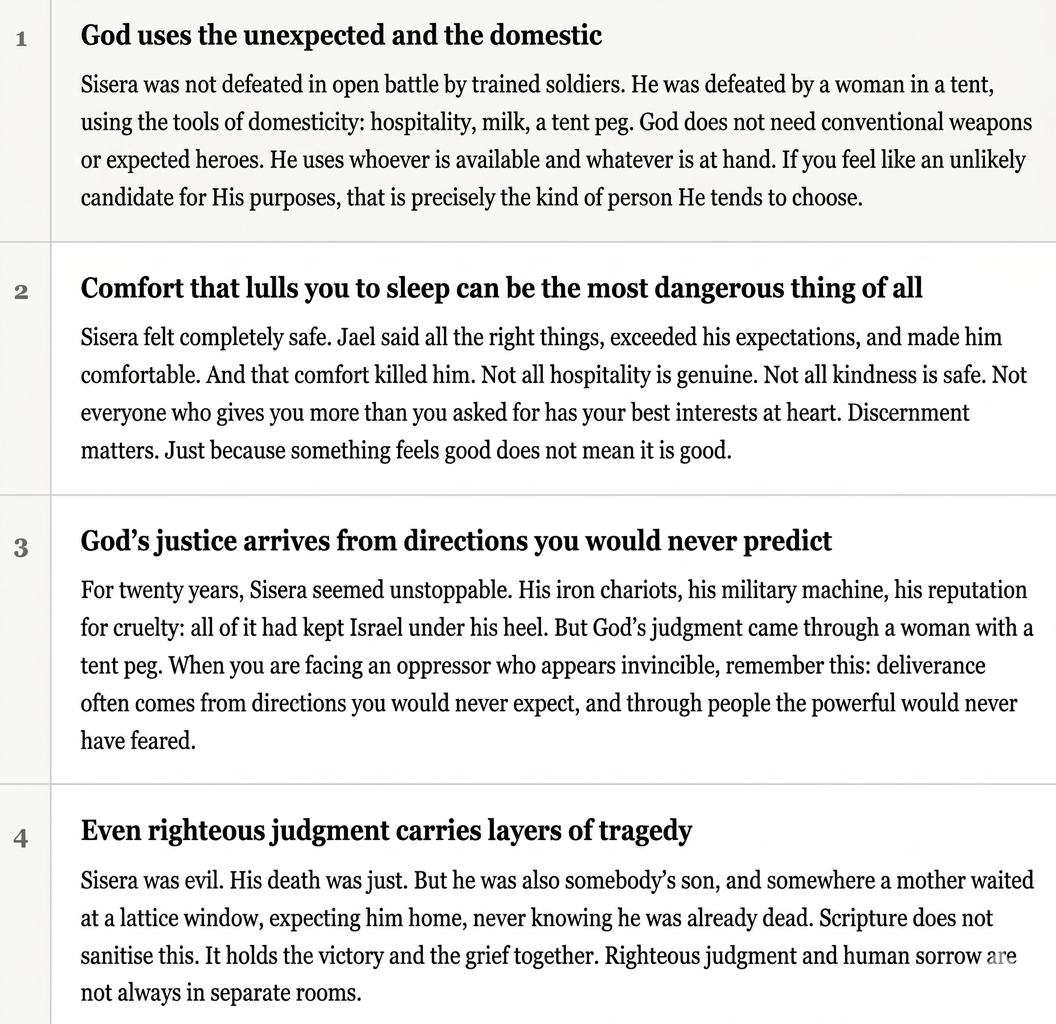
Four things the milk of Jael teaches us
She was not the only one
Jael joins a remarkable gallery of women in Scripture who defied every expectation and changed history through unlikely means. None of them fitted the box their culture had built for them. All of them acted boldly when boldness was costly.
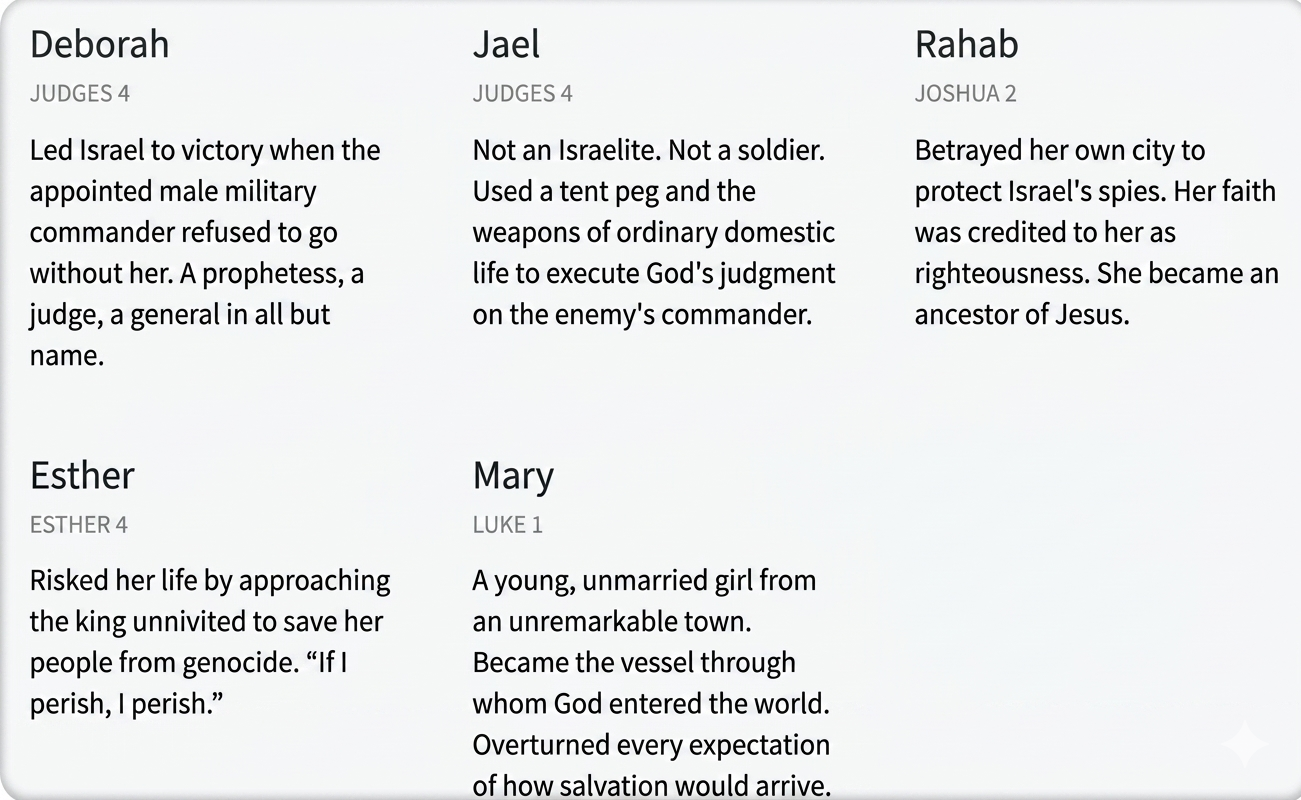
God delights in using the unlikely to accomplish the impossible. In Scripture’s economy, the powerful rarely see their undoing coming from the direction it actually arrives.



2 thoughts on “She Gave Him Milk. Then She Killed Him.”
Love this post, what an encouraging truth!
If i understand you well bro,
God works through humble and unexpected vessels. This gives hope to everyone who feels inadequate bah, God’s power is perfected in our weaknesses shey?
Message taken, God bless you Sir. 😇🙏😃
God uses women. God uses seemingly ordinary people who possess wisdom – people like you ma’am.