

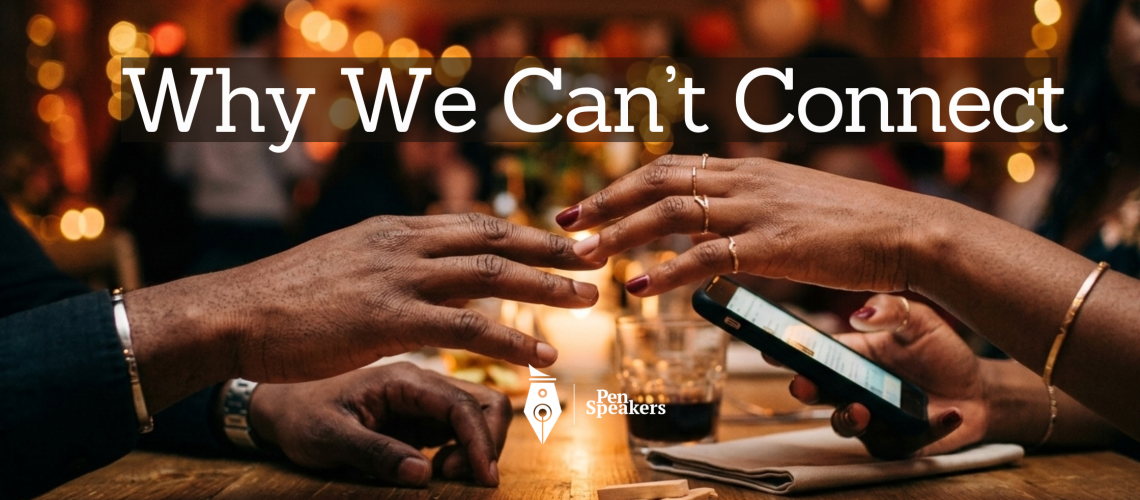
Have you noticed something strange at social gatherings lately?
We sit at beautifully arranged round tables – designed specifically to facilitate conversation and connection. The event organisers have thoughtfully seated us in groups of eight or ten, presumably so we can meet new people, share stories, and build relationships.
And yet, throughout the entire 90-minute programme, many of us will know next to nothing about the person sitting right beside us.
Why?
Because we’re all staring at our smartphones.
The Round Table Paradox
The round table is an ancient symbol of equality and community. King Arthur chose it specifically because there was no head of the table – everyone was equal, everyone could see and speak to everyone else.
It’s brilliant design for connection.
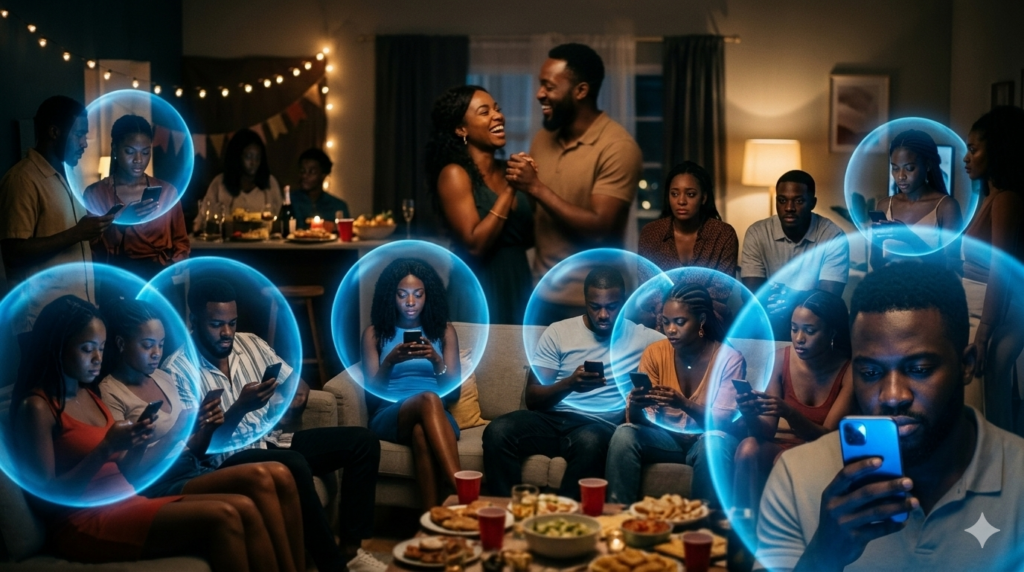
But we’ve turned it into something else entirely: a charging station for isolated individuals who happen to be in the same physical space.
I’ve watched this play out countless times:
- Programme starts, phones come out to record videos
- Speeches happen, people scroll through social media
- Meals are served, photos are taken for Instagram
- Breaks occur, everyone checks WhatsApp messages
- Programme ends, we leave having never had a single meaningful conversation with our tablemates
We were present. But we were absent.
Where This Behaviour Starts
Here’s what I’ve come to realise: The inability to connect at social gatherings isn’t really about the smartphones. It’s about what we’ve already lost at home.
If you eat family meals with screens around you – Dad on his laptop, Mum scrolling through her phone, children watching tablets – you’re training yourself (and your children) that physical presence doesn’t require actual engagement.
You’re learning to be alone together.
And that skill – or rather, that dysfunction – travels with you.
When you arrive at a wedding, a conference, a birthday party, you bring the same habits. You sit at a round table designed for connection, but you’ve already been conditioned to treat shared spaces as places for individual activity.
We can’t sit together and still act as individuals with smartphones in hand.
Well, we can. We do it all the time. But we shouldn’t. Because we’re missing the entire point of gathering.
What We’ve Forgotten
There’s an art to being present with people. It’s a skill that used to be passed down naturally – around dinner tables, in living rooms, during long car journeys without entertainment systems.
That skill includes:
- Making eye contact – Actually looking at the person speaking to you
- Asking questions – “What do you do?” “Where are you from?” “How do you know the host?”
- Listening without distraction – Not checking your phone mid-conversation
- Reading social cues – Knowing when to speak, when to listen, when to laugh
- Small talk that leads to real talk – Starting with weather and somehow ending up discussing life’s big questions
These aren’t complicated skills. But they require one thing we’re increasingly unwilling to give: undivided attention.
And undivided attention requires practice. Daily practice. The kind that happens when families eat together without screens, when friends meet for coffee without constantly checking notifications, when we choose presence over documentation.
The Documentation Trap
“But I’m just taking photos to remember the moment!”
Are you though?
Or are you so busy documenting the moment that you’re not actually experiencing it?
I’m not against photos. I’m not against sharing special occasions online. But I’ve noticed something troubling:
We’ve become more interested in proving we were somewhere than in actually being somewhere.
We attend weddings and watch the ceremony through our phone screens.
We go to concerts and record videos we’ll never watch again.
We sit at parties and post Instagram stories for people who aren’t there, whilst ignoring the people who are.
We’re present, but we’re performing presence rather than practicing it.
The Social Cost
Here’s what we lose when we choose screens over neighbours:
- Serendipity
Some of the most valuable relationships in my life began with random conversations at events. A casual chat with a tablemate who turned out to work in an industry I was curious about. A connection made during a boring programme that led to a lifelong friendship. You can’t plan these moments. But you can make yourself available for them – or you can scroll through Twitter and miss them entirely. - Empathy
When you actually talk to the stranger beside you, you discover they’re not a stranger. They’re someone’s parent, someone’s child, someone carrying burdens and dreams just like you. Face-to-face conversation builds empathy in ways digital interaction never can. - Community
We complain about loneliness and disconnection whilst simultaneously choosing isolation at every opportunity. We say we want community, but we won’t do the uncomfortable work of actually connecting with the person right next to us. - Joy
There’s a unique pleasure in unhurried, undistracted conversation. In laughter shared in real-time. In discovering commonalities with someone you’d never have met otherwise. That joy requires vulnerability – putting the phone down and risking an awkward conversation. But it’s worth it.
A Simple Challenge
Next time you attend a social gathering – a wedding, a conference, a birthday party, a dinner – try this:
Put your phone away. Not on silent. Not face-down on the table. Away. In your bag or pocket.
Then do something radical:
Introduce yourself to the person next to you.
Ask their name. Ask how they know the host. Ask what they do. Listen to their answer. Ask a follow-up question.
You might be surprised at what happens.
You might have an awkward five-minute conversation that fizzles out. That’s fine. You tried.
Or you might discover someone fascinating. Someone who challenges your thinking. Someone who becomes a friend, a mentor, a connection that changes your trajectory.
But you’ll never know if you’re scrolling through Instagram.
Connect With Your Neighbour
The round table was designed for connection.
The meal was designed for connection.
The gathering was designed for connection.
But connection requires something from you: the choice to be fully present.
Not documenting. Not scrolling. Not checking notifications.
Just there. Attentive. Open. Human.
We’ve spent years training ourselves to be comfortable being alone in crowds. Maybe it’s time to relearn what our grandparents knew instinctively:
When you sit at a table with others, actually sit with them.
The smartphones can wait.
The notifications can wait.
The Instagram story can wait.
But the person next to you? They’re right there. Right now.
Don’t miss them.
Questions for you:
- When was the last time you attended an event and actually had a meaningful conversation with someone you didn’t know before? What made that possible?
- If you have children, what are you modelling for them about presence and attention? What will they learn about connection by watching you at family meals and social events?
- What would it take for you to put your phone away for an entire event? What fears or discomforts does that bring up?
- Think about your most meaningful relationships. How did they begin? Chances are, they started with undivided attention – someone choosing to be fully present with you.
Let me know your thoughts in the comments. Have you noticed this trend? Do you struggle with it yourself? What helps you stay present?



8 thoughts on “Present But Absent: Why We Can’t Connect at Parties Anymore”
Quite very true Leke, we are growing into a culture of documentation without actual experiences. So many times physically present but not actually present.
The Simple challenge is the way to go!
Nicely reiterated Odi. The challenge may feel unnatural at first… I must admit.
Thanks for stopping by.
Thank you so much and may God bless you for this blog post bro. You’re very apt on this but the honest truth is that we aren’t wired same way or maybe we should blame this on our different temperaments. Lol. May God help us on this. Oncr again thank you bro. I enjoyed reading through. More wisdom in Christ Jesus’ name.
Amen and thank you for commenting. You have inserted a vital point about our temperament differences here. Some people would never actually initiate a conversation while at a desk because they are not wired that way. The point though is, if they are seated beside someone who is interested in initiating the conversation, but they are engrossed on their phone, that person will hesitate so as not to distract them. The opportunity for serendity is therefore lost. There are more single ladies and guys above 30 years old now than a decade ago. Think about it!
It is well said. In those days, life felt more intentional and family-centered. We kept diaries where we carefully wrote down phone contacts from events and ceremonies we attended.
Parents also bought novels and either read them to their children at night or encouraged them to read on their own, which greatly helped to improve vocabulary and grammar. After dinner, many families gathered to watch the NTA news together, and that usually marked the end of the day before the family said their night prayers.
Sadly, things are quite different today. Family prayers are becoming rare, greetings are fading, and everyone seems absorbed in their gadgets. Instead of visiting one another, people simply look at social media posts and assume everyone is fine. Physical visits now mostly happen only during celebrations, and even some of these celebrations are attended virtually while others watch online.
One can only hope that in the next twenty years we will not begin to see serious consequences, such as widespread eye problems caused by excessive smartphone use. Technology is useful, but we must be careful not to let it replace the human connections that once held families together.
Cecilia Oguntimehin
You struck some deep chords there Cecilia: ‘assuming someone is fine’ based on their social media statuses; ‘the issue of technology replacing human interaction’.
What has its pros may also bear some cons. We must be mindful of this in the balance of life.
Thank you for sharing your deep and vital thoughts.
What a reality of the life we live today as a people that you scripted. Innovations that would have made life beautiful have been abused such that we are far from one another even when we sit together in a closet.
It can only be hoped that humanity would be restored for our societies to be reformed.
It is very disheartening that, there is disconnection in every space we found ourselves: homes, school, churches, events, seminars, etc.
I once boarded a bus full of people at a park, I greeted no one answered because every single head: young and old was buried in their screens and when I shouted to repeat the greeting for them to hear me, you need to see the expressions on their faces.
Values that build society have been destroyed and efforts are neglected by everyone and everywhere to restore.
It is for those that have ears to hear what the Spirit says to the people and a wake-up call for everyone to be intentional in bringing back humanity.
Good job sir.
Wow! The experience you just narrated clearly depicts how low we have come. Back in the days, if a person joins at a park without a simple greeting, that person would be seen as snobbing or ill-trained. Now, greeting seems like an interruption of people’s occupied thought process. We simply must be careful before these devices make a robot of a whole generation. Thank you for sharing sir.